
Why this matters
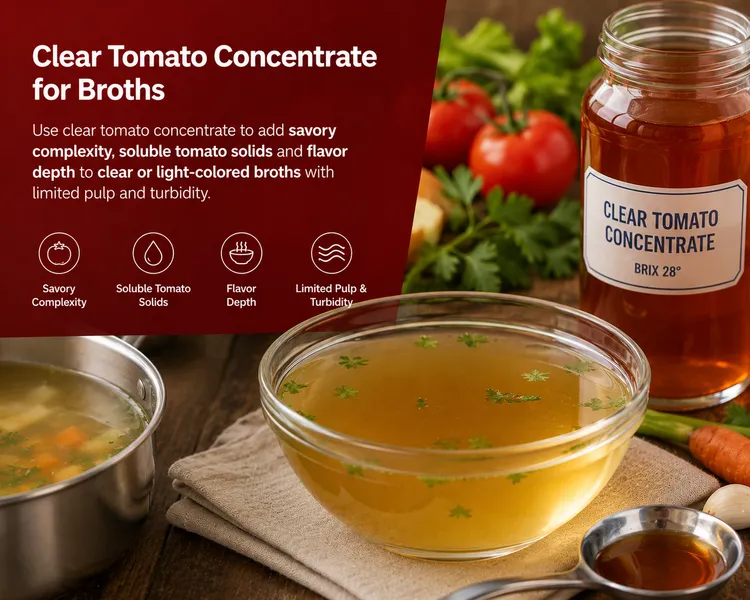
Broths and other culinary liquids often need savory depth without the heavy pulp, viscosity or visual tomato identity that conventional tomato paste can introduce. Clear tomato concentrate can provide a more soluble tomato contribution while allowing the broth to remain comparatively light in body.
Liquid systems require attention to pulp, turbidity, acidity, salt, aroma and suspended-solids behavior in addition to flavor. Even a modest change in concentrate strength or process history can affect color, yield, sensory balance and the amount of water or seasoning required.
Define the broth target first
Begin with the finished broth rather than the ingredient. Define whether the product should be visually clear, slightly cloudy or intentionally opaque, and determine how noticeable the tomato contribution should be.
A delicate chicken broth may need only background savory complexity, while a vegetable, beef or culinary base may support a stronger tomato-derived flavor. The desired color shift, acidity and aroma should be considered at the same time.
Ingredient selection
Choose juice for a direct liquid tomato base, juice concentrate for reconstitution efficiency, puree for body and suspended pulp, and clear concentrate for savory intensity with less visible tomato material.
For this topic, a logical first ingredient to evaluate is clear tomato concentrate. Treat that as a formulation hypothesis rather than a fixed rule. The preferred ingredient is the one that provides the required flavor contribution while preserving the intended broth appearance, texture, yield and cost.
Understand the lower-pulp advantage
Clear tomato concentrate is useful when tomato flavor is desirable but suspended pulp is not. Compared with paste or puree, it can contribute less physical body and less visible tomato material to the finished liquid.
This gives developers more freedom to control broth viscosity separately from tomato flavor, particularly when the finished product is intended to remain pourable and relatively transparent.
Normalize concentration before comparing samples
Supplier samples may have different Brix or soluble-solids concentrations. Comparing them at the same ingredient weight can make a more concentrated sample appear stronger simply because it contributes more tomato solids.
Normalize the first comparison to equivalent tomato solids where practical. After selecting the preferred flavor profile, optimize the final use rate and dilution ratio in the commercial formula.
Evaluate at final serving dilution
Concentrated ingredients can taste very different before dilution. Evaluate each candidate at the final broth concentration or at the actual use concentration in a culinary base.
This helps reveal whether the tomato character remains balanced once water, salt, spices, vegetables, proteins and other savory components are present.
Control turbidity
A broth described as clear or light-colored may have limited tolerance for suspended solids. Compare samples under consistent lighting and after the full manufacturing process because heat and ingredient interactions can alter visual clarity.
If turbidity is commercially important, define an internal visual reference or an analytical measurement that can be used consistently during supplier qualification.
Watch sedimentation
Even ingredients with low visible pulp can contribute fine suspended material. Over time, this may form sediment or a light deposit at the bottom of the package.
Evaluate the finished broth after realistic holding and storage conditions. Record whether sediment forms, whether it redistributes easily and whether the appearance is acceptable to the intended customer.
Check phase separation
Broths containing fats, proteins, gums, spice particles or vegetable extracts may separate during storage independently of the tomato ingredient. Clear tomato concentrate should therefore be evaluated in the complete formula.
Observe both immediate stability and longer-term phase behavior so a change in concentrate does not unintentionally create a new separation issue.
Color impact
Lower pulp does not mean zero color contribution. Clear tomato concentrate can still shift a broth toward amber, red or brown tones depending on concentration, processing and the surrounding ingredients.
Evaluate the finished product after thermal processing and at final dilution. This is especially important for pale broths where even a small color shift may be noticeable.
Savory flavor and aroma
Evaluate tomato aroma, cooked character, sweetness, acidity perception, savory depth, bitterness and aftertaste. The preferred concentrate should reinforce the broth without making the product taste unexpectedly like tomato soup unless that is the intended profile.
Sensory work should be performed in the complete broth because salt, herbs, spices, yeast extracts, meat flavors and vegetable notes can substantially change the way tomato-derived flavors are perceived.
Salt balance can shift
Adding concentrated tomato solids can change perceived saltiness and savory intensity even when the actual salt level remains unchanged. Recheck seasoning after changing supplier or usage rate.
If the product has a defined sodium target, maintain the analytical formulation requirement while adjusting flavor through the complete seasoning system.
Acidity and pH
Clear tomato concentrate may contribute natural acidity. Measure finished-product pH where it is part of the broth specification or process design rather than assuming acidity will remain unchanged.
Acid perception should also be evaluated sensorially because two concentrates with similar analytical pH may still produce different perceived balance in the finished broth.
Thermal processing matters
Heat can change tomato aroma, color and cooked flavor. Evaluate candidates after the intended pasteurization, hot-fill, retort or other thermal process rather than approving them solely from unheated bench samples.
If the broth is concentrated before final dilution, evaluate both the commercial concentrate and the final serving preparation.
Mixing and dissolution
Record how quickly the concentrate disperses in water or broth base and whether any localized concentration, residue or sediment remains after normal mixing.
Commercial trials should reproduce actual addition order, mixer speed and processing temperature so the ingredient is evaluated under realistic production conditions.
Use alongside other tomato ingredients when useful
Clear tomato concentrate can be combined with small amounts of paste, puree or juice when the formulation needs both savory depth and a controlled amount of tomato body or color.
This allows the developer to separate several functions—soluble flavor, color and physical texture—rather than expecting one ingredient to supply all of them.
Practical trial method
Evaluate the ingredient at final serving dilution and after the intended heat treatment. Measure sedimentation, turbidity and phase separation over the expected shelf-life pathway.
- Define the finished broth target, including clarity, color, savory intensity, acidity and any non-negotiable sensory attributes.
- Collect current specifications, COAs and representative clear tomato concentrate samples.
- Record Brix or solids, pH or acidity, color and relevant supplier information.
- Normalize candidate samples to equivalent tomato solids before the first comparison.
- Prepare controlled bench or pilot batches using the actual water ratio, seasoning system and addition order.
- Evaluate each candidate at the final serving dilution.
- Measure Brix, pH, color and any relevant turbidity or physical-stability attributes.
- Evaluate savory depth, tomato aroma, salt balance, acidity perception and aftertaste after the intended thermal process.
- Check sedimentation, phase separation and sensory stability after representative storage.
- Document the approved supplier, specification, use rate and change-control triggers.
What to record during trials
- Ingredient lot & COA
- Brix / concentration
- Solids normalization
- Batch weights
- Dilution ratio
- Addition order
- Process temperature/time
- pH & final Brix
- Color
- Turbidity / clarity
- Sedimentation
- Savory intensity
- Tomato aroma & flavor
- Storage result
Evaluate hot and cooled samples
Aroma and flavor perception can differ substantially between hot broth and a cooled laboratory sample. Evaluate the product at the temperature at which it will normally be consumed or used.
For concentrates intended for foodservice or industrial reconstitution, confirm that the intended dilution procedure produces consistent flavor and appearance.
Storage performance
Color, aroma, sediment and overall savory balance can change during storage. Retain representative samples and inspect them over the expected product-life pathway.
Pay particular attention to sedimentation, haze, flavor flattening, excessive cooked character and any separation that becomes more noticeable over time.
Compare total formulation economics
Compare concentrates on a usable-solids and finished-product basis rather than price per kilogram alone. A higher-concentration product may be used at a lower rate and can alter freight, storage and water requirements.
Include product recovery, packaging, dilution, seasoning adjustments and final yield in the commercial comparison.
Questions to ask the supplier
- How is the clear tomato concentrate defined and processed?
- What Brix or soluble-solids range applies?
- What normal pulp or turbidity level should buyers expect?
- Which clarity, color or turbidity attributes are guaranteed versus typical?
- What pH or acidity range applies?
- How would you describe the normal flavor and aroma profile?
- What normal lot-to-lot variation should buyers expect?
- How does the product behave after heating and dilution?
- What product process and crop/origin apply to this lot?
- What is the pack configuration, net weight and storage guidance?
- Which food-safety, quality and organic documents are available?
- How are lots identified and traced?
- What process, concentration, origin, specification or packaging changes require customer notification?
Define the approved specification
Once a concentrate is approved, document the characteristics that produced the desired broth. These may include Brix, pH or acidity, color, turbidity, sensory profile, dilution behavior and packaging.
Keep the approved ingredient specification linked to the finished-broth trial record so future supplier, crop or process changes can be compared against the same technical baseline.