
Why this matters
Dry tomato ingredients concentrate flavor and color without adding the same water load as puree or paste. In bakery systems, however, cut size, moisture level and hydration behavior become especially important because tomato pieces interact directly with dough moisture, mixing and baking conditions.
A sun-dried tomato that performs well as a salad inclusion may not behave the same way in bread. Pieces that are too dry can remain tough or pull water from the dough, while overly soft pieces can smear, break down during mixing or introduce more moisture than the formula was designed to handle.
Ingredient selection
Select powder when uniform tomato flavor is the main objective, granules when a smaller distributed particle is preferred, and larger flakes, julienne or diced sun-dried tomatoes when visible inclusions are part of the finished-product concept.
For this topic, a logical first ingredient to evaluate is sun-dried tomato julienne or diced. Treat that as a formulation hypothesis rather than a fixed rule: the best choice is the format that provides the desired appearance, flavor and texture while remaining compatible with mixing, proofing, baking and cost targets.
Match the cut to the bakery format
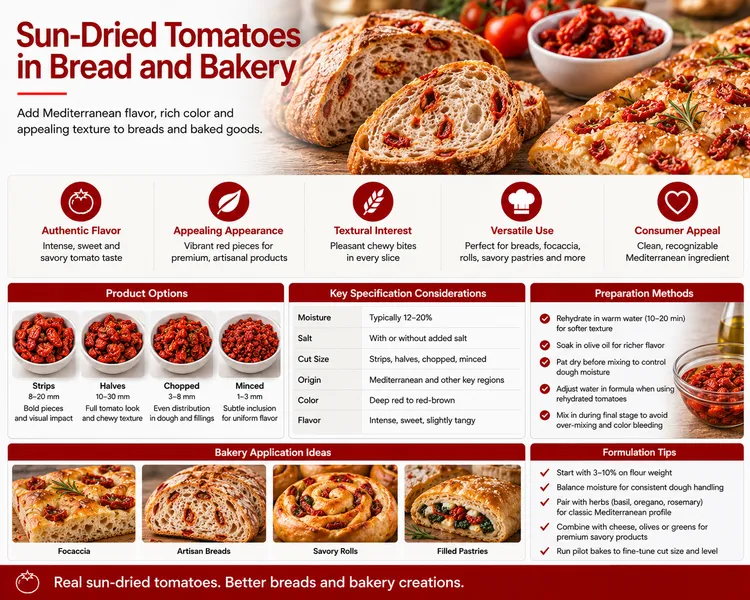
The appropriate cut depends on how the tomato should appear in the finished product. A julienne may provide visible streaks in focaccia or artisan breads, while smaller diced pieces can distribute more evenly through rolls, savory loaves and filled bakery products.
Larger pieces should also be evaluated for slicing performance. If the finished product is machine-sliced, oversized or unusually firm inclusions can affect slice appearance or cause local tearing around the tomato pieces.
Moisture level affects dough behavior
Sun-dried tomato products can vary meaningfully in residual moisture and softness. This influences how much water the inclusion absorbs from the dough and how the piece feels after baking.
Compare candidate ingredients in the actual dough system rather than by dry appearance alone. Record any water adjustment needed to maintain normal dough consistency, machinability and finished crumb.
Decide whether to prehydrate
Very dry pieces may benefit from controlled prehydration before they are added to the dough or filling. Prehydration can improve softness and reduce the tendency of the tomato to compete with the dough for available moisture.
If prehydration is used, record the water ratio, temperature and hydration time. Include retained hydration water in the formulation calculation so the trial can be repeated consistently at production scale.
Control addition order
Tomato inclusions can be damaged by excessive mixing. In many bakery processes, adding the pieces after initial dough development can help preserve visible identity, although the correct point of addition depends on the mixer, dough type and desired distribution.
Observe whether pieces remain intact, smear through the dough or accumulate in specific areas. A well-designed trial should balance even distribution with acceptable piece integrity.
Watch the effect on dough hydration
Added tomato pieces can change the apparent hydration of a dough over time. A dough that seems correct immediately after mixing may tighten during bulk fermentation as dry tomato pieces continue taking up moisture.
Evaluate dough consistency at the stages that matter operationally: after mixing, after rest or fermentation, during dividing and shaping, and before baking.
Evaluate mixing and machinability
Visible inclusions can influence dough handling through dividers, moulders, laminators or depositing equipment. Check whether the tomato pieces interfere with scaling accuracy, tearing, shaping or consistent filling.
If a candidate requires substantial changes to mixing time or equipment settings, include those operational effects in the overall ingredient comparison.
Color and flavor during baking
Baking can intensify or darken the appearance of exposed tomato pieces. Surface inclusions may experience stronger heat than pieces protected within the crumb, so both positions should be evaluated.
Sun-dried tomatoes provide concentrated tomato flavor and can contribute sweetness, acidity and savory depth. Review the finished product for balanced tomato character, excessive bitterness, overly cooked notes or other sensory changes after baking.
Use in focaccia
Focaccia is a natural application for visible tomato inclusions because pieces may be incorporated into the dough, placed on the surface or used in combination with herbs, cheese and oil.
Surface pieces should be tested for excessive drying or scorching. If tomatoes are added before baking, the process may need to balance visual appeal with protection from direct oven heat.
Use in savory breads and rolls
In pan breads, rolls and artisan loaves, uniform distribution may be more important than large visible pieces. Smaller diced tomatoes can provide a more consistent amount of tomato in each slice or serving.
Evaluate how the inclusion affects crumb structure, sliceability and moisture over the intended shelf life. Localized moisture differences around the tomato pieces can influence eating texture as the bread ages.
Use in savory fillings
Sun-dried tomatoes can also be used in bakery fillings for pastries, flatbreads, filled rolls and similar products. In these systems, compatibility with cheese, vegetables, oils or sauce components becomes important.
Evaluate the filling before and after baking for water release, tomato texture, flavor balance and filling stability. The preferred cut for a filling may be smaller than the cut used as a visible bread inclusion.
Practical trial method
Control addition order, hydration and dough water. Evaluate the tomato pieces after mixing, proofing, baking and representative storage rather than relying only on the incoming dry ingredient.
- Define the finished-product target, including visible tomato size, flavor intensity, finished softness and desired distribution.
- Collect current technical data and a representative sample from each candidate source.
- Record ingredient lot, cut size, moisture condition, pack format and available specification data.
- Decide whether each candidate will be used directly or prehydrated, and document the hydration conditions.
- Run a controlled bench or pilot dough using the real formula, addition order and mixing process.
- Record any change in dough water needed to maintain the target consistency.
- Observe piece integrity, dough distribution, machinability, proofing and shaping performance.
- Bake under the normal time and temperature conditions and evaluate finished color, piece softness, crumb structure and sensory profile.
- Repeat after the relevant storage period to assess bread softness, tomato texture and overall sensory stability.
- Document the approved supplier, cut size, moisture target, preparation method and change-control triggers.
What to document during a bakery trial
- Sun-dried tomato lot & COA
- Cut size and visual appearance
- Moisture condition
- Prehydration ratio and time
- Tomato inclusion rate
- Dough water adjustment
- Addition point and mixing time
- Proofing conditions
- Bake temperature and time
- Finished piece texture and distribution
- Color and sensory profile
- Post-storage result
Evaluate after storage
Finished bakery texture continues to change after cooling. Moisture can migrate between bread crumb and tomato pieces, affecting both crumb softness and inclusion chew.
If the product has a multi-day shelf life, evaluate representative storage points rather than approving the ingredient only on the day of baking. Check whether tomato pieces become too hard, too soft or cause undesirable localized moisture changes.
Questions to ask the supplier
- What product definition, drying process and crop/origin apply to this lot?
- What cut dimensions apply to the julienne or diced product?
- Which moisture parameters are guaranteed versus typical?
- What degree of normal variation in softness and color should be expected?
- Is prehydration recommended for bakery applications?
- How should opened packages be handled and stored?
- What is the pack configuration and net weight?
- Which food-safety, quality and organic documents are available for this program?
- How are lots identified and traced?
- What changes in cut size, moisture, drying process or origin require customer notification?
Define the approved bakery specification
Once the preferred product is selected, document the attributes that actually drove approval. This may include cut size, moisture, softness, color, flavor, preparation method and tolerance for breakage or fines.
Keep the approved ingredient lot and bakery trial results linked to the commercial specification. This makes future crop, supplier or process changes easier to assess against the performance originally accepted by the bakery team.