
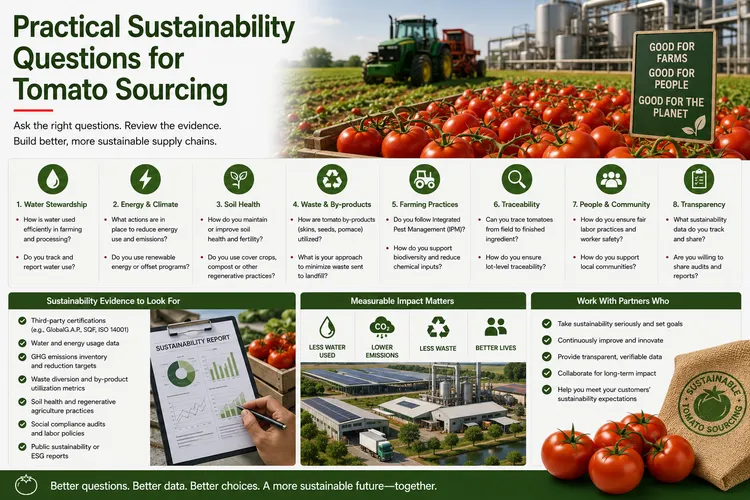
Why this matters
Sustainability in tomato sourcing is closely connected to agriculture, processing, packaging and logistics. Useful supplier evaluation therefore goes beyond general statements such as "responsibly sourced" or "environmentally friendly" and looks at the practices, measurements and evidence behind those claims.
Tomato processing is crop-linked, so commercial resilience also depends on planning, specification discipline and realistic logistics. A sourcing program should consider environmental and agricultural performance alongside technical suitability, food safety, continuity and total landed cost.
Start with measurable questions
Broad sustainability language is difficult to compare between suppliers. A more practical approach is to ask how performance is measured, which time period is being reported, what scope is included and whether the information relates specifically to the crop, processing site or ingredient being purchased.
Where possible, distinguish between policies, targets and demonstrated results. A stated commitment can be useful, but buyers should also understand what data or operating practices show progress against that commitment.
Ingredient selection
Separate must-have technical requirements from negotiable preferences. This creates alternate-source flexibility without compromising critical finished-product attributes. For this topic, a logical first group to evaluate is responsibly sourced tomato ingredients that already meet the required product specification.
Treat sustainability as one part of a complete sourcing decision rather than a replacement for technical qualification. The best ingredient is still the one that meets the finished-product target, manufacturing requirements, documentation needs, supply expectations and total cost while supporting the buyer's sourcing objectives.
Water management
Water is an important agricultural and processing consideration in tomato supply chains. Ask suppliers how irrigation needs are assessed, which water sources are used and what practices are in place to monitor or improve water efficiency.
The same water metric does not necessarily mean the same thing in every growing region, so context matters. Buyers may want to understand whether the supplier considers local water availability, irrigation method and site-specific risk when evaluating performance.
- What are the principal irrigation or agricultural water sources?
- Which irrigation methods are commonly used?
- How is water use measured or estimated?
- Are water-efficiency targets or improvement programs in place?
- How are water-related risks assessed by growing region?
- What evidence is available to support reported improvements?
Soil and farming practices
Long-term agricultural performance depends partly on how soil, crop rotations, fertility and field conditions are managed. Sustainability reviews can therefore include questions about the agronomic practices used across the supplier's grower network.
The objective is not to assume that one farming practice is appropriate everywhere, but to understand whether the supplier has a structured approach to maintaining productive fields and reducing avoidable agricultural risk.
- How are growers supported with agronomic guidance?
- Are soil conditions or fertility monitored?
- How are crop rotations or field-management practices considered?
- How are agricultural inputs documented?
- What programs exist to improve farming efficiency or resilience?
Crop protection and input management
Responsible sourcing reviews may also examine how crop-protection inputs and fertilizers are managed. Buyers should understand how growers receive guidance, what records are maintained and how compliance with the processor's agricultural program is verified.
This information can complement food-safety and pesticide-residue programs by showing how agricultural controls are managed before tomatoes reach the processing facility.
Energy use in processing
Concentrating tomatoes requires significant processing, including heating, evaporation, pumping, cooling and packaging. Ask how the processor measures energy use and whether improvement initiatives are tied to specific operations.
When suppliers report energy or emissions reductions, clarify the baseline year, facility scope and whether production volume has been taken into account. This makes comparisons more meaningful than a percentage reduction without context.
- Which processing activities account for the largest energy demand?
- How is energy consumption measured?
- Are intensity metrics used in addition to total consumption?
- What efficiency projects have been implemented?
- What reporting period and baseline are used for improvement claims?
Waste and tomato co-products
Tomato processing generates skins, seeds and other organic material in addition to wastewater and packaging waste. Ask suppliers how these streams are managed and whether useful co-products are recovered where appropriate.
A useful sustainability review distinguishes between material that is prevented, reused, recovered, recycled or disposed. This provides more detail than a single broad statement about waste reduction.
Packaging efficiency
Packaging can influence product protection, freight efficiency, warehouse handling and waste. Review the pack format together with actual net weight, pallet or container utilization and any relevant material-recovery options.
The most sustainable pack is not necessarily the one using the least material if it increases product damage, leakage or unusable residual product. Consider packaging performance across the complete supply chain.
Transport and sourcing distance
Logistics is another part of the sourcing footprint, but distance alone does not provide a complete comparison. Concentration, pack efficiency, shipment utilization and transport mode can all affect the amount of product moved for each unit of usable tomato solids.
Compare technically approved offers on landed usable solids, packaging efficiency, route reliability and total supply requirements rather than evaluating transport distance in isolation.
Traceability and evidence
Sustainability information becomes more useful when buyers can understand which farms, regions, processors or production programs it represents. Ask how supplier data is collected and whether claims relate to the entire operation or only selected sites or growers.
Where third-party certifications or verification programs are used, confirm the scope and current status. Certification can support supplier evaluation, but the buyer should still understand what the program actually covers.
Ask for comparable metrics
Sustainability data is difficult to compare if one supplier reports total annual consumption while another reports consumption per tonne of finished product. Ask for enough context to understand the denominator, reporting period and operational scope.
Consistency is often more valuable than an excessive number of metrics. A focused set of clearly defined indicators can make year-to-year progress and supplier comparisons easier to interpret.
Practical evaluation method
Sustainability review should sit alongside normal technical and commercial qualification. The objective is to understand both how the ingredient performs and how the relevant sourcing program is managed.
- Define the finished-product and sourcing requirements that cannot change.
- Identify the sustainability topics that are material to the program, such as water, farming practices, energy, waste, packaging or traceability.
- Collect current technical specifications and sustainability documentation from each candidate source.
- Ask for definitions, reporting periods and evidence behind key supplier claims.
- Normalize tomato solids or concentration before comparing technical usage rates and landed economics.
- Run a controlled bench or pilot batch to confirm the ingredient meets the required finished-product performance.
- Measure relevant attributes such as Brix/solids, pH, viscosity or Bostwick, color, yield and sensory profile.
- Compare sustainability information together with approved quality, packaging, lead time, documentation and continuity.
- Record the approved supplier, specification, evidence reviewed and any sustainability requirements tied to the program.
Questions to ask the supplier
- What product definition, process and crop/origin apply to this program?
- How are growers or agricultural suppliers approved and monitored?
- How is agricultural water use managed and measured?
- What soil or agronomic practices are promoted or monitored?
- How are crop-protection and fertilizer inputs managed?
- How is processing energy consumption measured?
- What waste and tomato co-product streams are tracked?
- How is packaging efficiency evaluated?
- Which sustainability metrics are reported and what baseline is used?
- What third-party certification or verification applies, if any?
- Can sustainability information be linked to the relevant processing site or sourcing region?
- How are lots identified and traced?
- Which food-safety, quality and organic documents are available for this program?
- What changes require customer notification?
Avoid vague claims
Terms such as sustainable, responsible, efficient or low-impact are difficult to evaluate without explanation. Ask suppliers to define what the term means in their program and which records or metrics support it.
This does not mean every sustainability program needs to use the same methodology. It means the buyer should have enough information to understand what is being claimed and whether it is relevant to the sourcing decision.
Review progress over time
Sustainability performance is better treated as an ongoing supplier-management topic than a one-time questionnaire. Where the program is commercially important, review changes in practices, metrics, certification status or reporting periodically.
Keep the sustainability record connected to the approved supplier and product specification. This makes it easier to identify when a change in origin, processing site or supplier program may also change the evidence supporting the original sourcing decision.