
Why this matters
Liquid tomato systems require attention to pulp, turbidity, acidity, salt, aroma and suspended-solids behavior in addition to flavor. The tomato format selected for a culinary base can influence not only taste and color but also viscosity, reconstitution, pumping, mixing and stability.
In a tomato-based formulation, an apparently small change in solids, finish, particle size or process history can alter yield, sensory profile and the amount of water, starch or other texture adjustment required. Ingredient selection should therefore be tied to the finished-product target rather than concentration alone.
Ingredient selection
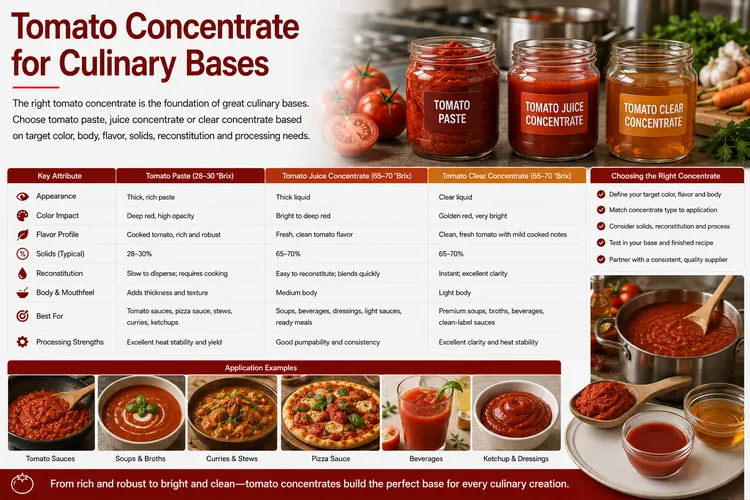
Choose juice for a more direct liquid tomato base, juice concentrate when reconstitution efficiency and shipping concentration are important, puree when additional body and suspended tomato solids are desired, and clear concentrate when savory tomato intensity is required with less visible pulp.
For this topic, a logical first ingredient to evaluate is tomato concentrate. Treat that as a formulation hypothesis rather than a fixed rule: the best answer is the ingredient that meets the finished-product target at an acceptable total cost and with reliable supply.
Match the format to the culinary base
Different culinary bases place different demands on the tomato ingredient. A soup concentrate may need moderate body and a clean tomato profile, while a sauce base, broth concentrate or cooking liquid may prioritize savory intensity, color or reconstitution efficiency.
- Paste: useful when concentrated tomato solids, color and body are important.
- Juice concentrate: useful when a more fluid tomato profile is desired with efficient transport and reconstitution.
- Puree: useful where natural pulp and moderate body support the finished texture.
- Clear concentrate: useful when tomato-derived flavor and soluble solids are needed with less suspended pulp.
Normalize solids before comparing suppliers
Concentrates with different Brix or total-solids levels should not be compared at the same ingredient weight without adjustment. A higher-concentration material introduces more tomato solids per kilogram and may therefore appear stronger in color, flavor and body.
Normalize samples to equivalent tomato solids before making the first technical and economic comparison. After the preferred ingredient is selected, optimize its actual use level and water balance in the production formula.
Reconstitution behavior
Where concentrate is diluted before use, evaluate how quickly and uniformly it disperses under realistic plant conditions. Record water temperature, addition order, mixing intensity and time required to achieve the intended uniformity.
Concentrates that require substantially different mixing conditions can influence batch time and operational simplicity even when the final liquid meets the same specification.
Body and viscosity
The required body of a culinary base may come partly from tomato solids and partly from other ingredients such as starches, gums, proteins or vegetable solids. Different tomato concentrates can change the amount of additional texture adjustment needed.
Measure viscosity or flow using the method relevant to the finished product and compare it after the full thermal process. A concentrate that appears similar before heating may behave differently after cooking, homogenization or storage.
Pulp, turbidity and suspended solids
Visible pulp can be desirable in some culinary bases and undesirable in others. Clarify whether the target is a naturally cloudy tomato appearance, a smooth opaque base or a relatively clear savory liquid.
Evaluate sedimentation and phase separation over time where these are relevant. Suspended-solids behavior can affect appearance, filling consistency and the distribution of tomato flavor from the first portion of a package to the last.
Color performance
Tomato concentrate can be an important source of red color, but the final appearance depends on concentration, thermal history, other ingredients and processing conditions. Compare candidates in the complete formula rather than judging the concentrate alone.
If color is critical, define whether the target is based on instrumental measurement, an approved visual reference or both. Review the result after heat treatment and storage because color can shift over the product's processing pathway.
Flavor and aroma
Evaluate tomato aroma, sweetness, acidity balance, cooked character, bitterness and overall savory impact. Concentrates produced with different processing histories can deliver noticeably different flavor profiles even when their analytical specifications are similar.
The preferred sensory profile depends on the finished base. A clean, lighter tomato note may suit a broth or beverage-style liquid, while a richer cooked profile may be more appropriate for a concentrated sauce or culinary base.
Practical trial method
Evaluate the ingredient at final serving or manufacturing dilution and after the intended heat treatment. Measure sedimentation or phase separation over the expected shelf-life pathway where these characteristics matter.
- Define the finished-product target, including tomato flavor, color, body, pulp level and target solids.
- Collect current technical data and a representative sample from each candidate source.
- Record supplier, ingredient lot, product specification and concentration.
- Normalize tomato solids or concentration before comparing usage rates.
- Reconstitute or incorporate each sample using the real water ratio, addition order and mixing conditions.
- Run a controlled bench or pilot batch using the actual process temperature and hold conditions.
- Measure relevant attributes such as Brix/solids, pH, viscosity or Bostwick, color, yield and sensory profile.
- Observe pulp distribution, turbidity, sedimentation or phase separation where relevant.
- Repeat after the intended thermal process and representative storage period.
- Document the approved supplier, specification, dilution assumptions and change-control triggers.
Evaluate after heat treatment
Culinary bases are often pasteurized, sterilized, hot-filled, retorted or otherwise heated before use or sale. Thermal processing can change tomato aroma, cooked character, color and viscosity.
Approve the ingredient using conditions that reasonably represent the commercial process. A sample that performs well at room temperature may not provide the same result after the intended heating and cooling sequence.
Check storage stability
Liquid systems may change during storage even when initial quality is acceptable. Monitor the parameters most relevant to the application, such as separation, sedimentation, viscosity, color and sensory profile.
Where the culinary base is later diluted or incorporated into another food, repeat the final preparation after storage to confirm that reconstitution and flavor remain acceptable.
Consider processing efficiency
Ingredient selection can affect more than formula cost. Concentration influences shipping and storage efficiency, while viscosity and dispersibility can influence pumping, transfer and mixing time.
Compare candidates on landed usable solids, finished yield and practical plant handling rather than unit price alone. The most economical concentrate is the one that supports both the formulation and the production process efficiently.
Questions to ask the supplier
- What exact product definition applies: paste, juice concentrate, puree or clear concentrate?
- What process and crop/origin apply to this lot?
- Which solids, Brix, pH, viscosity and color parameters are guaranteed versus typical?
- What pulp or suspended-solids characteristics should be expected?
- What reconstitution guidance is available?
- How much normal lot-to-lot variation should be expected?
- What is the pack configuration, net weight and storage guidance?
- Which food-safety, quality and organic documents are available for this program?
- How are lots identified and traced?
- What process, origin, specification or packaging changes require customer notification?
Define the approved sourcing specification
Once the preferred concentrate has been selected, document both the supplier specification and the application-specific criteria that drove approval. This may include concentration, dilution ratio, viscosity, color, flavor profile, pulp behavior and storage performance.
Keep the approved ingredient lot and trial results linked to the commercial specification so future supplier or crop changes can be evaluated against the conditions that originally produced acceptable finished-product performance.