
Why this matters
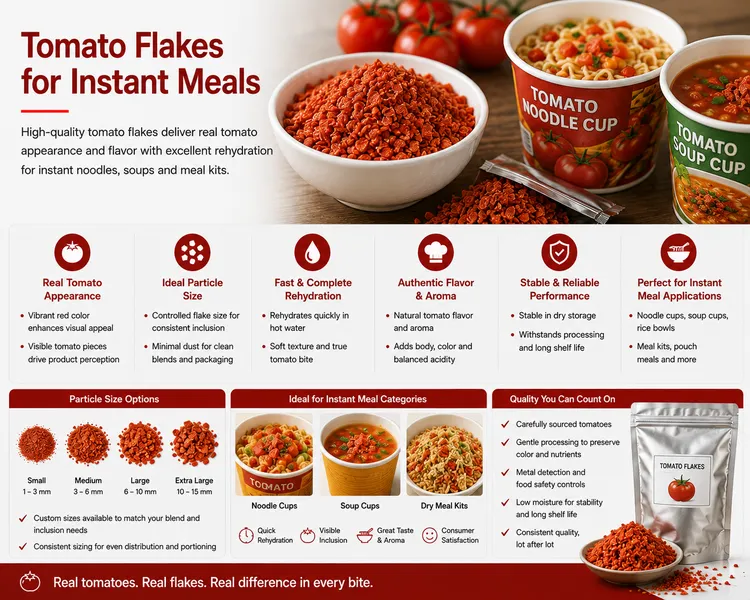
Dry tomato ingredients concentrate flavor and color without adding the water load of puree or paste, but particle size, moisture and dispersibility become central. In instant meals, tomato flakes also need to rehydrate within the actual preparation time available to the consumer.
A flake that is too large or dense may remain tough after a short steep, while a product that is too fragile may break down into fines during blending and transport. The useful specification therefore balances visible identity, dry handling and prepared-product texture.
Ingredient selection
Select powder for uniform flavor, granules for controlled particle distribution and flakes or diced dried tomato for visible inclusion. For this topic, a logical first ingredient to evaluate is tomato flakes.
Treat that as a formulation hypothesis rather than a fixed rule: the best answer is the ingredient that meets the finished-product target at an acceptable total cost and with reliable supply. In some formulations, flakes may also be paired with tomato powder or granules to combine visible pieces with broader tomato flavor and color distribution.
Particle size and visible identity
Flake dimensions influence how clearly tomato is seen in the dry package and after preparation. Larger pieces can provide stronger visual identity, but they generally require more time and water contact to soften than smaller pieces.
Define the useful particle range around the finished meal rather than appearance alone. Consider whether flakes need to remain visibly distinct after hydration or whether they should soften substantially into the surrounding soup, sauce or noodle system.
Rehydration is part of the specification
Instant products often depend on a defined preparation method, such as adding hot water and waiting several minutes. Tomato flakes should therefore be evaluated using the intended water temperature, fill volume and hold time rather than under ideal laboratory hydration conditions.
Check both the center and surface texture of the rehydrated pieces. A flake may look hydrated externally while still retaining an undesirably firm or dry center.
Test in the complete meal system
Rehydration can change when flakes are combined with noodles, starches, dehydrated vegetables, seasoning powders and other ingredients competing for available water. Evaluate the tomato flakes in the full meal rather than only in water.
Product geometry also matters. In a cup meal, some flakes may remain near the top, while others settle between noodles or other dry components. Testing the actual pack configuration helps identify whether hydration is reasonably consistent throughout the serving.
Control breakage and fines
Tomato flakes can be damaged by conveying, aggressive mixing or repeated handling. Excessive breakage reduces visible inclusion size and creates smaller particles that may distribute or hydrate differently from the intended product.
During pilot production, observe the material before and after blending and filling. If significant breakage occurs, review addition order, mixer intensity, transfer methods and the supplier's particle-size specification.
Moisture and dry handling
Dry tomato ingredients can pick up moisture during storage. Moisture exposure may increase clumping, reduce flowability and change how flakes distribute through the meal components.
Confirm the supplier's storage guidance and evaluate the material under realistic warehouse and plant conditions. Opened-package handling can be particularly important when a bag is used over multiple production runs.
Color and flavor after preparation
Tomato flakes should be evaluated for both dry appearance and prepared-product performance. Hot water or cooking can change color, aroma and perceived tomato intensity, so a visually attractive dry flake does not automatically provide the desired finished result.
Assess tomato character, cooked notes, sweetness, acidity balance and any atypical flavor or aroma after the normal consumer preparation. If tomato powder or another tomato ingredient is also present, evaluate the contribution of the complete tomato system.
Practical trial method
Control addition order, dry handling and hydration. Evaluate candidate flakes in the complete meal matrix and use the actual preparation conditions expected for the finished product.
- Define the finished-product target, including visible flake size, desired tomato flavor and prepared texture.
- Collect current technical data and a representative sample from each candidate source.
- Record ingredient lot, particle-size information, moisture data and pack condition.
- Normalize tomato solids or concentration before comparing usage rates where candidate ingredients differ materially.
- Run a controlled bench or pilot blend using the real addition order and mixing conditions.
- Observe flake breakage, fines generation, dry distribution and any segregation in the complete meal mix.
- Prepare the product using the intended water volume, water temperature and hydration or cooking time.
- Evaluate flake softness, piece integrity, color, tomato flavor and overall sensory profile.
- Repeat after representative storage to confirm that dry handling and hydration performance remain acceptable.
- Document the approved supplier, specification, particle-size range and change-control triggers.
What to record during hydration trials
- Tomato flake lot and specification
- Target particle-size range
- Meal or cup fill weight
- Water volume and temperature
- Preparation or hold time
- Flake softness and center texture
- Piece integrity after stirring
- Color and visible distribution
- Tomato aroma and flavor
- Post-storage preparation result
Questions to ask the supplier
- What product definition, drying process and crop/origin apply to this lot?
- What particle-size range applies to the tomato flakes?
- How are fines and oversized pieces controlled?
- What rehydration behavior is typical for this product?
- Which parameters are guaranteed versus typical?
- What moisture and storage guidance applies?
- What is the pack configuration and net weight?
- Which food-safety, quality and organic documents are available for this program?
- How are lots identified and traced?
- What changes in drying, particle size or sourcing require customer notification?
Approve against the actual preparation method
Final approval should reflect the way the consumer will prepare the meal. If the package promises a short hot-water steep, evaluate the flakes under that condition rather than giving them additional time simply to obtain an acceptable result.
Keep the approved preparation method, supplier lot, sensory observations and particle-size specification with the trial record. This provides a practical baseline if later lots hydrate differently.