
Why this matters
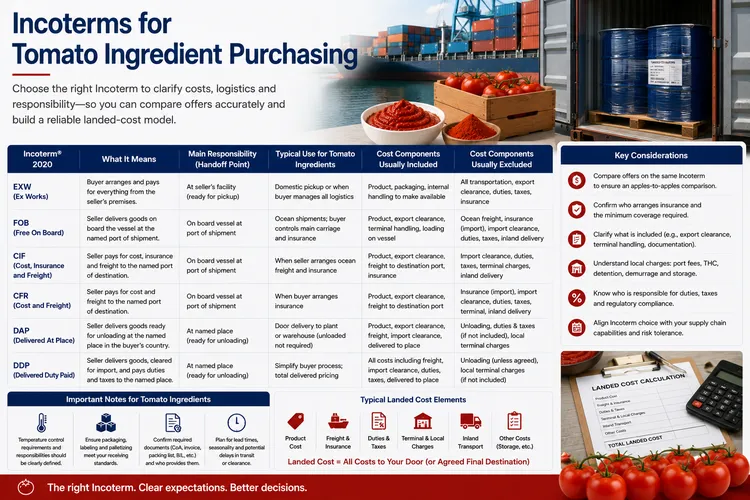
International tomato ingredient quotations can look similar on the surface while assigning very different costs and logistics responsibilities to the buyer. The quoted price therefore needs to be read together with the commercial delivery term, named location, packaging format, shipment size, expected lead time and the services included in the offer.
Tomato processing is crop-linked, so commercial resilience depends on planning, specification discipline and realistic logistics. Comparing suppliers only on the headline price can hide meaningful differences in inland transport, export handling, ocean freight, destination charges, storage, documentation and the operational work required to move product into the receiving plant.
Start with the named delivery point
A commercial term is most useful when it is paired with a clearly identified place or port. When reviewing an offer, confirm exactly where the supplier's quoted responsibility is intended to end and where the buyer's logistics responsibility begins.
Avoid comparing two quotations as though they are equivalent when they reference different handoff points. A supplier quotation tied to the processing facility, export terminal, destination port or buyer's receiving location can represent very different logistics scopes even when the ingredient itself is identical.
Compare the complete logistics scope
Build a comparison that identifies which costs are included in each offer and which must be added separately. This provides a cleaner view of the actual procurement decision and reduces the risk of discovering major logistics costs after the supplier has already been selected.
- Origin pickup or inland transportation
- Export handling and documentation
- Port or terminal handling where relevant
- Main international freight
- Destination handling and inland delivery
- Packaging, pallets or other shipping-unit costs
- Storage or demurrage exposure where relevant
- Customs or import-related coordination handled outside the quoted offer
Ingredient selection
Separate must-have technical requirements from negotiable preferences. This creates alternate-source flexibility without compromising critical finished-product attributes. For this topic, a logical first group to evaluate is export tomato ingredients that already meet the technical specification required for the application.
Treat that as a sourcing hypothesis rather than a fixed rule. The best answer is the ingredient that meets the finished-product target at an acceptable total cost and with reliable supply. The commercial comparison should therefore combine technical suitability with logistics, packaging efficiency, lead time, documentation and continuity.
Normalize the product before comparing freight
Tomato ingredients with different concentrations should not be compared on delivered weight alone. A higher-solids tomato paste may require fewer kilograms to deliver the same amount of usable tomato solids, which can change the effective freight and packaging cost of the formula.
Normalize candidate products to equivalent tomato solids before comparing total delivered economics. This helps separate the effect of product concentration from the effect of transportation and makes supplier comparisons more meaningful.
Include packaging efficiency
Pack format affects more than warehouse handling. Drum, bin, tote or other configurations can influence container utilization, shipment weight, receiving labor, storage footprint and the amount of usable product recovered from each pack.
Confirm actual net weight, pack count, pallet or loading configuration and the expected number of units per shipment. Two suppliers quoting the same ingredient price may produce materially different landed economics when packaging efficiency is taken into account.
Lead time is part of the commercial comparison
International sourcing should be evaluated against the actual planning horizon of the manufacturing operation. Review production timing, booking time, transit, destination handling and inland movement rather than treating supplier lead time as a single number.
Longer or more variable supply lanes may require additional inventory or earlier purchasing commitments. Those requirements should be considered alongside the supplier price when comparing otherwise similar tomato ingredient programs.
Documentation affects shipment readiness
Technical and shipping documentation should be discussed before the first commercial shipment. An attractive price loses value if the required certificates, specifications, lot documents or other program records are unavailable when product is ready to move.
- Current product specification
- Certificate of analysis or lot documentation
- Food-safety and quality documentation
- Organic documentation where applicable
- Pack and net-weight information
- Lot-identification and traceability records
- Commercial shipment documents required for the agreed supply program
Build a landed-cost comparison
Compare offers on landed usable solids, approved quality, packaging efficiency, lead time, documentation and continuity—not unit price alone. A useful landed-cost worksheet keeps the product assumptions and logistics assumptions visible so that purchasing teams can see why one offer appears more or less competitive.
At minimum, record the product concentration, quantity, quoted commercial basis, named location, included transportation scope, expected additional logistics costs and final receiving point. Use the same comparison method for every candidate.
Consider supply continuity
The lowest landed-cost route is not always the most resilient route. Tomato processing seasons, port congestion, equipment availability, transit variability and warehouse capacity can all affect whether the ingredient arrives when production needs it.
When two technically acceptable sources are close in total cost, commercial teams may also evaluate route flexibility, alternative shipment options, inventory requirements and the supplier's ability to communicate quickly when schedules change.
Practical evaluation method
Review the commercial offer and ingredient performance together. This prevents the sourcing decision from selecting the cheapest logistics structure for a product that ultimately requires a higher usage rate or does not meet the finished-product target.
- Define the finished-product target and the attributes that cannot change.
- Collect current technical data and a representative sample from each candidate source.
- Record the quoted commercial term and the named handoff location for each offer.
- Identify which origin, freight, destination and inland-delivery costs are included and which must be added separately.
- Normalize tomato solids or concentration before comparing usage rates and freight efficiency.
- Run a controlled bench or pilot batch using the real addition order and process conditions.
- Measure relevant attributes such as Brix/solids, pH, viscosity or Bostwick, color, yield, piece integrity and sensory profile.
- Confirm packaging configuration, shipment quantity, expected lead time and required documentation.
- Calculate the effective landed cost of the technically approved ingredient at the buyer's receiving point.
- Document the approved supplier, product specification, commercial basis and change-control triggers.
Questions to ask the supplier
- What product definition, process and crop/origin apply to this lot?
- Which parameters are guaranteed versus typical?
- What commercial delivery term is being quoted?
- What exact named place or port applies to the quotation?
- Which transport and handling costs are included in the quoted price?
- Which logistics responsibilities remain with the buyer?
- What is the pack configuration, net weight and storage guidance?
- What is the typical shipment quantity for this pack format?
- What lead time should be used for normal purchasing plans?
- Which food-safety, quality and organic documents are available for this program?
- How are lots identified and traced?
- What changes require customer notification?
Keep quotations comparable
Supplier offers should be brought back to a common commercial basis before a final sourcing decision is made. If one offer includes more of the logistics chain than another, make the required adjustments explicitly rather than comparing the quoted numbers without context.
Record the assumptions used in the comparison, particularly freight, shipment size, product concentration and receiving location. This makes the sourcing model easier to update when logistics costs, crop availability or supplier conditions change.