
Why this matters
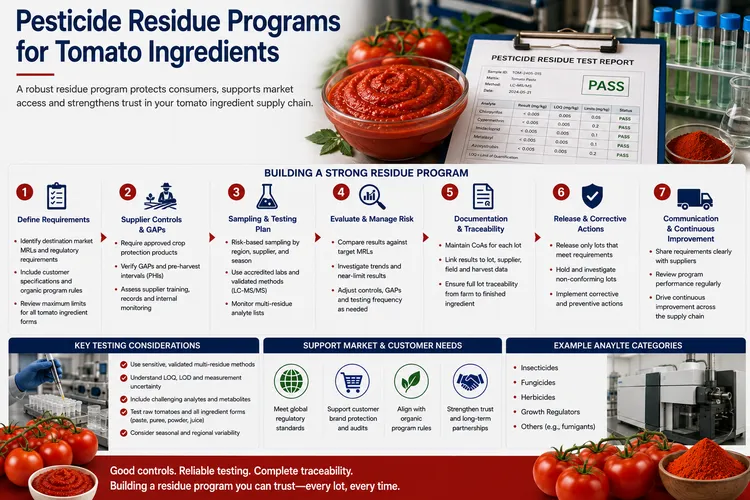
A pesticide residue program should connect agricultural controls, supplier qualification, analytical testing, lot traceability and final disposition into one documented process. The goal is not simply to collect laboratory reports, but to understand how residue risk is managed from the crop through the processed tomato ingredient.
Requirements can also differ according to the destination market, customer program, ingredient type and whether the product is sold under an organic certification scheme. Defining these expectations before commercial shipments begin helps avoid situations where a technically acceptable tomato ingredient cannot be used because the required residue documentation or testing scope was not established in advance.
Start with the destination market
The intended market for the finished product should be identified early in the sourcing process. Residue acceptance criteria should be based on the requirements applicable to that market and the buyer's own customer or internal standards.
Avoid assuming that a residue program developed for one country, customer or certification scheme automatically applies to another. When the same ingredient may be shipped into multiple markets, define whether a common program can support all destinations or whether market-specific review is required.
Build the program around risk
A useful program combines preventive controls with verification. Agricultural practices, supplier qualification and traceability can help reduce risk before the ingredient reaches the laboratory, while analytical testing provides an additional verification step.
The appropriate testing frequency and scope can depend on factors such as supplier history, crop origin, ingredient classification, organic status, previous results and customer requirements. The program should document why a particular approach has been selected rather than treating every supplier and lot identically without regard to risk.
Ingredient selection
Use product-specific specifications rather than copying a generic tomato paste requirement onto diced, powdered, pureed or clarified tomato ingredients. For this topic, a logical starting point is the actual organic or conventional tomato ingredient intended for the finished-product program.
The ingredient still needs to meet normal formulation and process requirements, including target solids, texture, color, flavor, pack format and cost. Residue compliance is an important qualification criterion, but it should be integrated with the full technical and commercial approval process.
Understand the supplier's agricultural controls
Ask how the processor or supplier manages agricultural inputs before tomatoes reach the processing facility. The exact system will vary by supply chain, but buyers should understand who controls grower approval, input recommendations, field records and verification.
- How are growers or agricultural suppliers approved?
- How are crop-protection inputs controlled or communicated?
- What field or application records are maintained?
- How is compliance with the processor's agricultural program verified?
- How are exceptions or prohibited-use concerns investigated?
- How is crop origin linked to processing and finished ingredient lots?
Define the testing plan
The testing plan should identify what is being sampled, when samples are collected, which analytical scope is required and how results are reviewed. A report is useful only when it can be linked clearly to the relevant ingredient lot or defined production program.
Buyers should also understand whether testing is performed on raw tomatoes, intermediate material, finished ingredient or another defined sample point. When supplier testing is used as part of the approval program, clarify whether results are lot-specific, periodic or based on a broader crop-season monitoring plan.
Sampling matters
Analytical quality begins with the sample. Define who collects the sample, from which material, at what point in the process and how the sample identity is preserved. The laboratory result should be traceable back to the material it is intended to represent.
- Identify the ingredient and supplier lot sampled.
- Record sampling date and sample location.
- Define whether the sample represents one lot, multiple lots or a crop program.
- Preserve sample identification through shipment to the laboratory.
- Retain the laboratory report reference with the supplier lot record.
Review laboratory information
Where laboratory testing forms part of the program, buyers should understand the analytical scope and how the reported results will be interpreted. Different analytical panels or methods may not necessarily cover identical substances, so the scope should be reviewed against the intended program rather than judged only by the length of the laboratory report.
The documentation process should also define who reviews results, what constitutes an acceptable result and what happens when a finding requires additional technical or regulatory assessment.
Lot-level documentation
Residue information becomes much more useful when it is connected to traceability. Keep supplier lot numbers, test reports, certificates, receiving records and disposition decisions linked so that the basis for approval can be retrieved later.
- Supplier and manufacturing site
- Product name and ingredient specification
- Supplier lot or production code
- Crop or origin information where relevant
- Sampling reference
- Laboratory or test report reference
- Applicable acceptance criteria
- Review and approval status
- Final lot disposition
Organic and conventional programs
Organic and conventional tomato programs should be clearly distinguished in supplier documentation and internal purchasing records. Organic status should be supported by the documentation and identity-preservation controls required for the applicable organic program.
Organic certification does not eliminate the need for a broader supplier-control process. Buyers may still need to consider traceability, residue-risk assessment, documentation review, lot controls and customer-specific requirements as part of their overall quality program.
Prevent mix-ups in storage and shipment
Where a supplier handles both organic and conventional tomato products, ask how identity is maintained through processing, filling, storage and shipment. Product labels, lot coding, warehouse controls and shipping records should make the intended program clear.
Buyers should apply the same discipline internally after receiving. Organic status, supplier lot identity and any program-specific restrictions should remain visible through warehouse and manufacturing records.
Define escalation rules
A residue program should establish what happens when a result is unexpected, incomplete or potentially outside the defined acceptance criteria. The affected lot should not depend on informal decision-making while technical teams determine the appropriate next step.
Define who reviews the result, who communicates with the supplier, whether additional testing or documentation is required and who has authority to release, hold or reject the material. Keep the investigation and final disposition linked to the affected lot.
Supplier change control
Changes in crop origin, grower program, manufacturing site, organic status or other relevant sourcing conditions may affect the assumptions behind an established residue program. Define which changes require customer notification and technical review.
A supplier that changes a material part of the approved supply chain should not be treated automatically as equivalent simply because the product name and basic specification remain unchanged.
Practical qualification method
Define sampling, acceptance limits, retain samples, escalation rules and documentation ownership before the first commercial delivery. Residue review should form part of the broader ingredient qualification process rather than operate as an isolated purchasing document.
- Define the finished-product destination and identify the residue and organic program requirements relevant to the intended market.
- Confirm whether the candidate ingredient is conventional, organic or subject to another customer-specific sourcing program.
- Collect current technical specifications, supplier quality documentation and available information about agricultural and residue controls.
- Define the required sampling plan, analytical scope, testing frequency and documentation expectations.
- Confirm how laboratory reports and other records will be linked to supplier lots.
- Establish acceptance, escalation and lot-disposition responsibilities before commercial receiving begins.
- Run the normal formulation or pilot evaluation to confirm the ingredient also meets solids, pH, viscosity, color, yield and sensory requirements.
- Document the approved supplier, specification, residue-control program and change-notification triggers.
Questions to ask the supplier
- What product definition, process and crop/origin apply to this lot?
- Is this program conventional, organic or subject to another sourcing standard?
- How are growers and agricultural inputs controlled?
- What residue monitoring or testing program applies to the ingredient?
- At what stage are samples collected?
- Is testing lot-specific, periodic or based on a crop-season program?
- How are analytical reports linked to production lots?
- Which parameters are guaranteed versus typical?
- What is the pack configuration, net weight and storage guidance?
- Which food-safety, quality and organic documents are available for this program?
- How are organic and conventional lots segregated and identified?
- How are lots identified and traced?
- How are unexpected analytical findings investigated?
- What changes require customer notification?
Keep the program current
Residue programs should be reviewed when suppliers, origins, destination markets, organic programs or customer requirements change. Historical acceptance of a supplier does not automatically mean that every future crop, origin or program can be handled under exactly the same controls.
Periodic review of supplier performance, analytical history, documentation quality and traceability can help determine whether the existing testing and verification plan remains appropriate.