
Why this matters
Commercial chili combines tomato ingredients with beans, meat or alternative proteins, spices, water, fats and sometimes starches or other texture-building ingredients. The tomato system must provide enough body and flavor to support those inclusions without becoming excessively thick, thin or overly dominant.
Tomato ingredients in prepared foods must perform through pumping, filling, cooking, chilling or freezing where applicable, storage and consumer reheating. In a tomato-based formulation, an apparently small change in solids, finish, particle size or process history can alter yield, pumping behavior, sensory profile and the amount of water or thickener required.
A well-balanced chili formulation therefore treats tomato ingredients as both flavor ingredients and structural components of the sauce phase.
Build the tomato base in layers
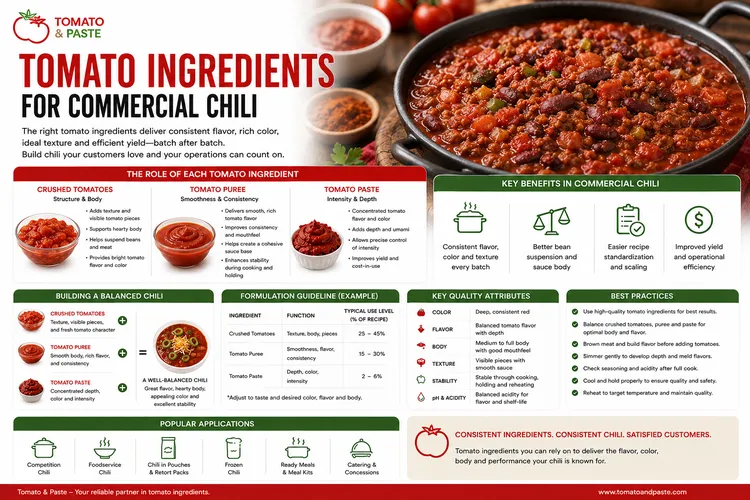
Using more than one tomato format can make commercial chili easier to control. Crushed tomatoes can provide visible tomato texture, puree can create a smoother continuous sauce phase, and paste can strengthen tomato solids, color and overall body.
The proportions depend on whether the target is a chunky chili with recognizable tomato material or a smoother sauce that primarily suspends beans and protein pieces.
Ingredient selection
Use higher-body ingredients where water separation is a concern, and combine paste with puree or crushed tomatoes where both concentrated tomato solids and recognizable texture are required.
For this topic, a logical first combination to evaluate is crushed tomatoes and paste. Puree may also be added where a smoother background texture or more uniform tomato distribution is desired.
Treat that as a formulation hypothesis rather than a fixed rule. The best answer is the ingredient combination that meets the finished-product target for body, flavor, color, suspension and yield at an acceptable total cost and with reliable supply.
Crushed tomatoes for texture
Crushed tomatoes can contribute visible tomato material and create a less homogeneous sauce appearance. They may be especially useful in chili styles where the tomato should remain recognizable rather than disappearing completely into the sauce.
Evaluate the incoming particle character and the way it changes through mixing, pumping and cooking. Excessive mechanical or thermal treatment can reduce visible texture.
Paste for concentrated tomato solids
Tomato paste can increase sauce body and tomato intensity without requiring the same ingredient volume as a lower-solids product. It can also help strengthen color where beans, meat, spices and other dark ingredients reduce the apparent redness of the finished chili.
Because paste concentration can vary, usage should be compared on an equivalent tomato-solids basis. A direct weight-for-weight substitution between different Brix products may change both sauce thickness and yield.
Puree for a continuous sauce phase
Tomato puree can help create a smoother tomato background around beans and protein pieces. It may provide more distributed tomato character than crushed tomatoes while remaining less concentrated than paste.
When a supplier change affects puree concentration or consistency, normalize the comparison before deciding whether recipe water or thickener must be adjusted.
Bean suspension
One of the practical texture goals in chili is keeping beans and other inclusions distributed through the sauce instead of allowing them to settle rapidly or appear surrounded by excessive free liquid.
Sauce body should be high enough to support suspension while still allowing pumping, filling and portioning. Evaluate the finished product after the normal holding period because beans can continue absorbing moisture and changing the apparent sauce-to-solid ratio.
Protein and sauce balance
Meat, poultry or alternative proteins can contribute fat, moisture and soluble components that affect the sauce phase during cooking. A tomato system that appears appropriate before protein addition may change after the complete formula is heated.
Evaluate tomato ingredients in the actual protein system and monitor the balance between sauce adhesion, free liquid and finished yield.
Normalize tomato solids before supplier comparisons
Supplier samples should not automatically be compared at equal ingredient weight if their Brix or solids differ. A more concentrated paste or puree can deliver more tomato material at the same usage rate.
Normalize candidate products to equivalent tomato solids first, then compare sauce body, flavor, color, yield and total formulation cost.
Water balance
Tomato concentration directly affects the amount of water entering the formula. When switching between paste, puree and crushed tomatoes, recalculate both tomato solids and total water rather than adjusting only one ingredient line.
Water changes can influence viscosity, bean hydration, finished yield and the amount of thickener or starch required.
Spices and tomato intensity
Chili powders, cumin, peppers, garlic, onion, smoke notes and other seasonings can compete with or complement tomato flavor. A strong spice system may require enough tomato solids to maintain a balanced base, while excessive tomato can mask the intended spice profile.
Compare supplier samples in the fully seasoned formula because the apparent tomato flavor of a diluted ingredient can differ substantially from its behavior in the finished chili.
Salt and acidity
Tomato contributes natural acidity, while salt affects both flavor and the perception of tomato intensity. Confirm whether incoming crushed tomatoes, puree or other tomato ingredients contain added salt and include that contribution in the recipe calculation.
Evaluate pH and sensory acidity according to the product-development and quality program. The correct target depends on the complete formulation and process.
Color after cooking
Commercial chili often contains dark spices, browned proteins and beans that can reduce the visual impact of tomato color. Evaluate color after the full cook rather than judging the tomato ingredient alone.
If color consistency is commercially important, compare candidate tomato ingredients under the same heating, holding and storage conditions.
Viscosity and flow
Chili should be thick enough to suspend beans and coat inclusions, but it must still move through plant equipment and fill containers consistently. Excessive body can create pumping and filling challenges, while low body may produce separation or poor portion consistency.
Record viscosity, Bostwick or another agreed flow measurement at a defined temperature and sample age so supplier and plant-trial comparisons remain meaningful.
Thermal processing
Cooking changes tomato flavor, sauce body, protein texture and bean hydration. In shelf-stable or heavily processed products, the final thermal treatment may also change color and viscosity substantially.
Pilot the intended thermal process as closely as practical and compare candidates after the complete process rather than only before heating.
Holding and reheating
Chili often becomes thicker during holding because beans, starches and proteins continue interacting with the sauce. Consumer or foodservice reheating can change the balance again.
Evaluate the product immediately after cooking and again after the expected hold, storage or reheat sequence so the approved formula reflects actual service conditions.
Separation and free liquid
Excessive free liquid can make chili look weak and can lead to inconsistent portions. Review whether separation develops during hot holding, chilling or storage.
If a supplier change alters tomato solids or consistency, determine whether the root cause is the tomato ingredient, total formula water, bean absorption or another thickening component before changing the specification.
Practical trial method
Pilot the full thermal and storage cycle. Evaluate sauce body, bean suspension, separation, color, flavor and viscosity after the same hold time used in commercial production.
- Define the target tomato intensity, sauce body, bean suspension, color, spice balance and finished yield.
- Collect current technical data, specifications and representative samples from each candidate source.
- Record the Brix or solids concentration of paste, puree and other concentrated tomato ingredients.
- Normalize tomato solids before comparing supplier usage rates.
- Recalculate water balance when changing tomato format or concentration.
- Run a controlled bench or pilot batch using the real beans, protein system, spices, fats and addition order.
- Record mixing and pumping conditions that may affect texture and visible tomato particles.
- Measure relevant attributes such as Brix/solids, pH, viscosity or Bostwick, color and finished yield.
- Evaluate sauce adhesion, bean suspension, tomato intensity, spice balance and visible separation.
- Repeat the evaluation after the complete thermal process and normal commercial hold time.
- Where relevant, evaluate again after chilling, freezing, storage or reheating.
- Document the approved supplier, ingredient combination, specification and change-control triggers.
What to compare between supplier samples
- Brix / tomato solids
- Crushed particle character
- Sauce body
- Viscosity / Bostwick
- Bean suspension
- Free-liquid separation
- Tomato flavor intensity
- Spice balance
- Color after cooking
- pH / acidity
- Hot-hold performance
- Reheat performance
- Finished yield
Questions to ask the supplier
- What product definition, process and crop/origin apply to this lot?
- What Brix or solids range applies to the paste, puree or crushed tomato product?
- What consistency or viscosity characteristics are guaranteed?
- What particle or finish specification applies to crushed or pureed products?
- Which color and pH/acidity parameters are guaranteed versus typical?
- Does the product contain added salt or other ingredients?
- What is the pack configuration, net weight and storage guidance?
- What shelf life applies under the recommended storage conditions?
- Which food-safety, quality and organic documents are available for this program?
- How are lots identified and traced?
- What changes in crop origin, process, concentration, particle profile or packaging require customer notification?
Commercial evaluation
Compare tomato systems on finished-chili economics rather than ingredient price alone. Paste, puree and crushed tomatoes contribute different amounts of solids, water, texture and processing value.
Include delivered cost, equivalent tomato solids, actual usage rate, water adjustment, thickener demand, finished yield, pack efficiency and supply reliability in the comparison.