
Why this matters
Minestrone is a multi-component soup in which tomato must work alongside vegetables, beans, pasta or grains, broth, herbs and seasonings. The tomato system affects not only flavor and color but also the perceived body of the broth and the visual balance between liquid and pieces.
Tomato ingredients in prepared foods must perform through pumping, filling, cooking, chilling or retort where applicable, storage and consumer reheating. In a tomato-based formulation, an apparently small change in solids, finish, particle size or process history can alter yield, pumping behavior, sensory profile and the amount of water or thickener required.
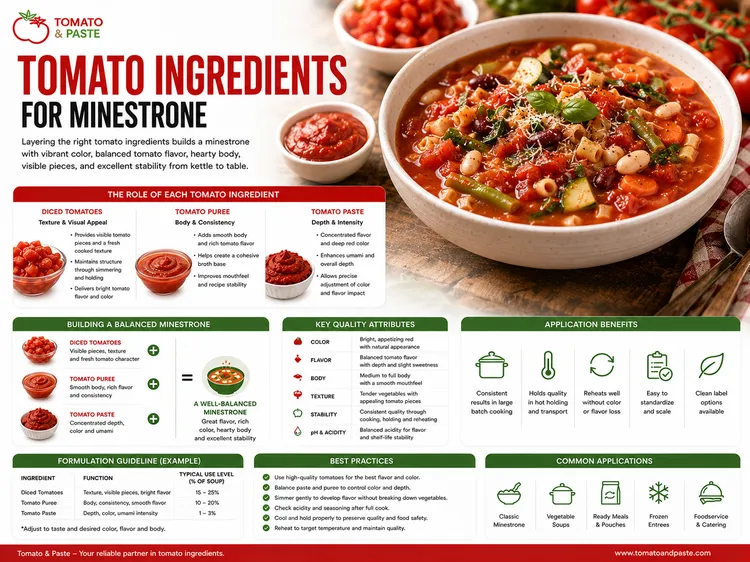
A useful minestrone formulation therefore separates the functions of the tomato ingredients: diced tomatoes can provide recognizable pieces, puree can create a continuous tomato background, and paste can increase concentration, color and broth body without requiring the same ingredient volume.
Build the tomato system in layers
Using more than one tomato format can make minestrone easier to balance. Instead of asking a single ingredient to provide every attribute, formulators can assign different roles to diced tomatoes, puree and paste.
Diced tomatoes contribute visible pieces and a fresh tomato identity. Puree can distribute tomato flavor and color throughout the broth. Paste can add concentrated solids and strengthen tomato character when the soup would otherwise become too dilute.
Ingredient selection
Use higher-body tomato ingredients where water separation is a concern, and combine paste with puree or pieces when both broth body and recognizable tomato are required.
For this topic, a logical first combination to evaluate is diced tomatoes and puree, with paste added as needed to increase concentration and broth intensity.
Treat that as a formulation hypothesis rather than a fixed rule. The best answer is the ingredient combination that meets the finished-product target for flavor, color, body, piece identity and yield at an acceptable total cost and with reliable supply.
Diced tomatoes for visible identity
Diced tomatoes can help the finished soup look less homogeneous and provide recognizable tomato pieces among beans, vegetables and pasta. Piece size should fit the visual scale of the other ingredients in the recipe.
Evaluate both incoming piece definition and post-process integrity. Diced tomatoes may soften or break down during pumping, mixing, prolonged cooking, hot holding or reheating.
Puree for continuous tomato character
Tomato puree can provide a more uniform background of tomato flavor and color throughout the broth. It may also add moderate body without producing the concentrated character associated with larger additions of paste.
When supplier puree concentrations differ, compare them at equivalent tomato solids before deciding which one produces better yield or flavor.
Paste for concentration and broth body
Tomato paste can increase tomato solids efficiently when the formula needs more color, flavor intensity or body without substantially increasing the volume of tomato ingredient.
Because paste concentration can vary, its usage should be calculated on a solids basis. A direct kilogram-for-kilogram replacement between different Brix products may change both the amount of tomato solids and the water balance of the soup.
Balance broth body with visible pieces
The desired minestrone texture is usually more fluid than a pasta sauce but more substantial than a clear broth. The tomato system should support the vegetables and beans without making the soup excessively thick or masking the individual pieces.
Evaluate spoonability, flow and broth-to-solids balance after the soup has completed its normal cooking and holding cycle. Ingredients such as pasta, rice, beans and starch-containing vegetables may continue to absorb liquid after the initial cook.
Normalize tomato solids
Supplier comparisons should account for concentration before sensory or economic conclusions are drawn. A more concentrated paste or puree may appear stronger simply because it contributes more tomato solids at the same ingredient weight.
Normalize candidate ingredients to equivalent tomato solids, then compare broth color, tomato flavor, body, yield and finished cost under the same process conditions.
Piece integrity through processing
Diced tomatoes share the soup with other fragile components, so process severity matters. High shear, aggressive agitation or long thermal exposure may reduce piece definition.
Where visible tomato pieces are important, review the addition point as well as the ingredient specification. Adding diced tomatoes at a different stage may change how much mechanical and thermal treatment they receive.
Vegetable and bean interactions
Minestrone recipes can contain substantial amounts of beans, carrots, celery, onions, leafy vegetables and other inclusions. These components contribute their own solids, flavors and water-holding behavior.
Evaluate tomato ingredients in the complete soup rather than in a simple diluted tomato base. A tomato level that appears appropriate on its own can seem weaker or stronger once other vegetables, seasonings and broth components are present.
Pasta, grains and broth absorption
Pasta, rice and other grains can continue absorbing liquid during cooking, holding and storage. This may increase apparent soup viscosity and reduce the amount of free broth available around the inclusions.
When these ingredients are part of the commercial recipe, evaluate the tomato system after the actual hold time instead of setting the final broth body immediately after mixing.
Salt, herbs and flavor balance
Tomato acidity and savory character interact with salt, herbs, garlic, onion, stock components and other seasonings. The correct tomato level should support these flavors without overwhelming the vegetable profile.
Confirm whether incoming tomato ingredients contain added salt and account for that contribution when setting the finished seasoning target.
Color through the complete process
Tomato ingredients provide much of the red-orange background color associated with minestrone. Thermal processing, storage and other vegetables can change the final appearance.
Compare candidate tomato systems after the intended process using the complete recipe. Evaluate the broth and visible tomato pieces together because the perceived color of the soup depends on both.
Separation and suspended solids
A well-balanced broth should remain visually integrated around the vegetable and bean pieces. Excessive serum separation or settling can make the product look inconsistent from the beginning to the end of a container.
Evaluate separation after production and after the relevant holding or storage period. Also observe whether gentle stirring or reheating returns the soup to a uniform condition.
Thermal processing
Cooking conditions affect tomato flavor, color, body and diced-piece integrity. The same tomato system may perform differently in a fresh refrigerated soup, a frozen product or a shelf-stable process.
Pilot the full thermal pathway as closely as practical and record temperature, time and mixing conditions so supplier comparisons remain meaningful.
Holding and reheating
Minestrone often changes after cooking because pasta, beans and vegetables continue interacting with the broth. During hot holding or reheating, the soup may become thicker and the relative amount of visible liquid may decrease.
Evaluate the product at the actual service point or consumer preparation stage. That is usually more relevant than judging viscosity and piece distribution immediately after the cooking kettle.
Practical trial method
Pilot the full thermal and storage cycle. Evaluate separation, piece integrity, color, flavor and viscosity after the same hold time used in commercial production.
- Define the target broth color, tomato intensity, body, visible-piece level and total finished yield.
- Collect current technical data, specifications and representative samples from each candidate source.
- Record the Brix or solids concentration of paste, puree and other concentrated tomato ingredients.
- Normalize tomato solids before comparing supplier usage rates.
- Confirm diced tomato piece size and any relevant piece-integrity specification.
- Run a controlled bench or pilot batch using the real vegetables, beans, pasta or grains, seasonings and addition order.
- Record mixing or pumping conditions that may affect diced-piece integrity.
- Measure relevant attributes such as Brix/solids, pH, viscosity or Bostwick, color and finished yield.
- Evaluate broth body, tomato flavor, vegetable balance and visible tomato-piece integrity.
- Repeat the evaluation after the full thermal process and normal commercial hold time.
- Where relevant, evaluate again after chilling, freezing, storage or consumer reheating.
- Document the approved supplier, ingredient combination, specification and change-control triggers.
What to compare between supplier samples
- Brix / tomato solids
- Diced piece size
- Piece integrity
- Broth color
- Tomato flavor
- pH / acidity
- Broth viscosity / flow
- Separation after holding
- Pasta or grain absorption effect
- Hot-hold performance
- Reheat performance
- Finished yield
- Overall sensory balance
Questions to ask the supplier
- What product definition, process and crop/origin apply to this lot?
- What Brix or solids range applies to the paste or puree?
- What diced size and piece-integrity characteristics apply?
- Which consistency, color and pH/acidity parameters are guaranteed versus typical?
- Does the product contain added salt or other ingredients?
- What finish or particle specification applies to puree or paste?
- What is the pack configuration, net weight and storage guidance?
- What shelf life applies under the recommended storage conditions?
- Which food-safety, quality and organic documents are available for this program?
- How are lots identified and traced?
- What changes in crop origin, process, concentration, diced size or packaging require customer notification?
Commercial evaluation
Compare candidate tomato systems on finished-soup economics rather than the price of one ingredient alone. Paste, puree and diced tomatoes may each contribute different amounts of solids, water, visible pieces and processing value.
Include delivered cost, equivalent tomato solids, usage rate, finished yield, pack efficiency, processing behavior and supply reliability when comparing approved combinations.