
Why this matters
Consistency is one of the most useful functional attributes in tomato paste because it helps describe how the material flows and how much body it can contribute to a finished product. For formulators, procurement teams and quality groups, Bostwick measurements provide a practical way to compare this behavior under defined conditions.
The specification is the commercial translation of finished-product performance. Normalize comparisons before approving a source. In a tomato-based formulation, an apparently small change in solids, finish, particle size or process history can alter yield, pumping behavior, sensory profile and the amount of water or thickener required.
A Bostwick result should therefore be treated as one part of the specification rather than a stand-alone definition of quality. It is most useful when connected to a repeatable test method and to actual performance in the customer's application.
What Bostwick measures
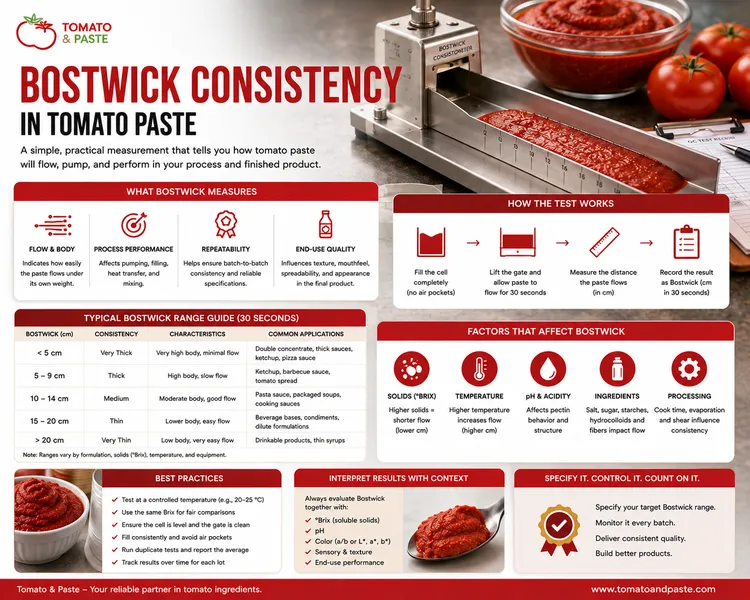
A Bostwick test measures the distance a sample flows along a graduated trough during a defined time period after a gate is released. The result provides an operational measure of consistency or flow under the specified test conditions.
In general, a sample that travels a shorter distance behaves as a thicker or higher-body material under the test, while a sample that travels farther behaves as a more fluid material. The numerical result should always be interpreted using the same preparation, temperature, timing and equipment conditions.
Bostwick is not the same as viscosity
Bostwick and viscosity both describe aspects of flow, but they are not interchangeable measurements. Bostwick is a practical flow-distance test, while other viscosity methods may measure resistance to flow under different controlled conditions.
Two products with similar Bostwick values can still differ in mouthfeel, particle profile or behavior under pumping and shear. Likewise, a small difference in Bostwick may or may not matter in the final application.
Why test conditions matter
Temperature, sample concentration, preparation method and test timing can influence a Bostwick result. A meaningful comparison requires consistent conditions across all samples.
Buyers should confirm the supplier's test method rather than comparing numbers from different sources without context. If one supplier reports a value at different solids or under different sample conditions, the results may not be directly comparable.
Normalize solids before comparing consistency
Tomato paste concentration has a direct effect on apparent body. Comparing two products at different Brix values can confuse concentration effects with structural differences in the paste.
When evaluating suppliers, normalize samples to equivalent tomato solids whenever practical. Then compare Bostwick, sensory texture, yield and finished-product performance under the same process conditions.
Ingredient selection
Start with solids/Brix and process type, then add consistency, color, pH/acidity, finish, microbiology, package and lot documentation. For applications where body and flow are important, a logical first ingredient to evaluate is tomato paste specified by Bostwick.
That does not mean the lowest or highest Bostwick value is automatically best. The correct target depends on the finished product, processing system, dilution level, pumpability, texture requirements and total formulation design.
Treat the suggested starting point as a formulation hypothesis rather than a fixed rule. The best answer is the ingredient that delivers the required finished-product performance at an acceptable total cost and with reliable supply.
Process type and body
Tomato processing history can influence the structural behavior of the paste. Products produced under different process conditions may show different consistency characteristics even when their soluble-solids concentration is similar.
Buyers should therefore evaluate Bostwick together with process type and application performance rather than assuming that concentration alone predicts body.
Finish and particle structure
Finish and insoluble-solids profile can also influence how a tomato paste feels and flows. Particle structure may affect apparent thickness, smoothness, pumping behavior and finished-product mouthfeel.
A Bostwick specification can control one aspect of flow, but it does not fully describe particle size or texture. Where these attributes are important, include finish and sensory evaluation in the technical approval process.
Application performance
Bostwick becomes most useful when connected to the real product. A paste may meet the incoming consistency range but still require a different water or hydrocolloid adjustment in a sauce, soup or prepared food.
Run candidate ingredients in the complete formulation. Evaluate hot and cooled consistency where relevant because many food systems continue to develop structure as they cool and rest.
Pumping and filling considerations
Consistency can influence plant handling as well as consumer texture. Higher-body materials may require more pumping force or different transfer conditions, while more fluid materials may change fill behavior or finished-product cling.
Where plant handling is sensitive, document pumping, mixing and filling performance during pilot or production trials rather than relying only on a laboratory Bostwick result.
Batch-to-batch consistency
One of the strongest uses of Bostwick is monitoring repeatability over time. A specification range can help procurement and quality teams identify lots that are materially different from the approved performance window.
Historical lot data can also be useful. A value may technically remain within specification but still be unusual relative to normal supplier performance, which may justify additional application review when consistency is critical.
Practical trial method
Run the candidate ingredient in the actual formula at equal tomato solids whenever possible. Record sample preparation, temperature and batch conditions so Bostwick and sensory comparisons remain meaningful.
- Define the finished-product flow and body targets and identify attributes that cannot change.
- Collect current technical data, specifications and representative samples from each candidate source.
- Confirm the supplier's Bostwick method, sample preparation and reporting basis.
- Record Brix or concentration and normalize tomato solids before comparing candidate ingredients.
- Measure incoming Bostwick under controlled and repeatable conditions.
- Run a controlled bench or pilot batch using the actual addition order and process conditions.
- Measure relevant attributes such as Brix/solids, pH, Bostwick or viscosity, color and yield.
- Evaluate texture, smoothness, cling, pumpability and sensory body.
- Measure hot and cooled consistency where the product changes structure during cooling.
- Repeat the evaluation after the relevant thermal process and storage condition.
- Document the approved supplier, Bostwick range, specification and change-control triggers.
What to compare between supplier samples
- Brix / tomato solids
- Bostwick test method
- Reported Bostwick range
- Sample temperature
- Process type
- Finish / particle profile
- Hot consistency
- Cooled consistency
- Finished-product body
- Pumping / filling behavior
- Water or thickener requirement
- Finished yield
Questions to ask the supplier
- What product definition, process and crop/origin apply to this lot?
- What Brix or solids range is specified?
- What Bostwick range is guaranteed?
- What sample preparation and test temperature are used?
- What test time and equipment procedure are used for the reported value?
- Which consistency parameters are guaranteed versus typical?
- What finish or particle-related specification applies?
- What color and pH/acidity specifications also apply?
- What is the pack configuration, net weight and storage guidance?
- Which food-safety, quality and organic documents are available for this program?
- How are lots identified and traced?
- What changes in process, consistency range, origin or specification require customer notification?
Commercial evaluation
Consistency can affect economics through water addition, hydrocolloid usage, yield and plant throughput. A paste with a higher purchase price may still be competitive if its application performance reduces another formulation or processing cost.
Compare candidates on equivalent tomato solids and total finished-product economics, including delivered cost, usage rate, thickener demand, yield, pack efficiency and supply reliability.