
Why this matters
Tomato paste is commonly purchased at a substantially higher concentration than the tomato base ultimately used in a sauce, soup, ready meal or other prepared food. Converting that concentrated ingredient into a lower-solids system requires a simple but disciplined mass balance.
The specification is the commercial translation of finished-product performance. Normalize comparisons before approving a source. In a tomato-based formulation, an apparently small change in solids, finish, particle size or process history can alter yield, pumping behavior, sensory profile and the amount of water or thickener required.
Dilution calculations are also important when changing suppliers. Two tomato pastes with different Brix values should generally not be substituted kilogram for kilogram if the objective is to preserve the same amount of tomato solids in the finished recipe.
The basic mass-balance principle
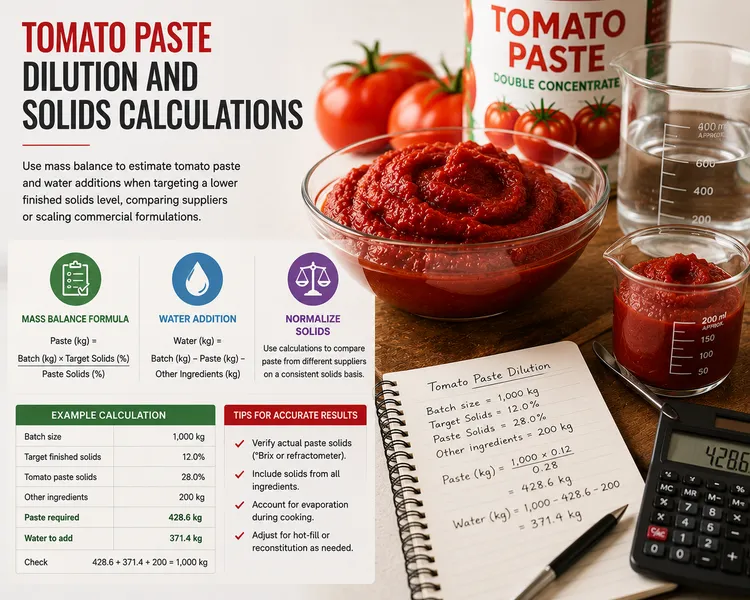
In the simplest paste-and-water calculation, the amount of tomato solids entering the system from the paste is assumed to remain in the diluted product. Water changes the total mass and concentration, but it does not add tomato solids.
The basic relationship can be expressed as:
Paste mass × paste solids fraction = finished mass × target solids fraction
Once the required paste mass is known, the water addition can be estimated as:
Water addition = target finished mass − paste mass
Percentage values should be converted to decimal fractions when used directly in the equation. For example, 36% solids is represented as 0.36 and 12% solids as 0.12.
Simple dilution example
Suppose a manufacturer wants to prepare 1,000 kg of a tomato base at 12% tomato solids using a paste treated for calculation purposes as 36% solids.
The required tomato solids in the finished batch are:
1,000 kg × 0.12 = 120 kg tomato solids
The approximate paste requirement is therefore:
120 kg ÷ 0.36 = 333.3 kg paste
The approximate water addition is:
1,000 kg − 333.3 kg = 666.7 kg water
This is a simplified mass balance. A commercial formulation may also contain sugar, salt, vinegar, starch, vegetables, flavors or other ingredients that contribute mass or measured soluble solids and therefore need to be included in the full formulation calculation.
Converting one paste concentration to another
Mass balance is also useful when replacing one tomato paste with another while maintaining approximately the same tomato-solids contribution.
If a formula currently uses a lower-solids paste and the replacement paste is more concentrated, less replacement paste will generally be required to deliver the same amount of tomato solids.
The relationship can be expressed as:
Current paste mass × current solids fraction = replacement paste mass × replacement solids fraction
The difference in ingredient mass is normally considered when adjusting water or another liquid portion of the formula so the total batch size remains unchanged.
Example of supplier normalization
Assume a current recipe uses 100 kg of paste at 30% solids. That ingredient contributes approximately 30 kg of tomato solids.
If a candidate paste is treated as 36% solids, the approximate quantity needed to provide the same 30 kg of tomato solids is:
30 kg ÷ 0.36 = 83.3 kg replacement paste
In a simple substitution, the approximately 16.7 kg difference in paste mass would then become part of the water or liquid-balance review. The finished formula should still be validated because concentration is not the only difference between tomato pastes.
Brix and formulation calculations
Brix is widely used in commercial tomato specifications and formulation work, but the calculation basis should be clearly defined within the company and supplier documentation. Use the specification and analytical basis agreed for the program rather than assuming that every reported concentration value is directly interchangeable.
For purchasing and supplier comparisons, record the actual declared or measured concentration used in the calculation. This avoids silently calculating with a nominal value when the approved specification permits a range.
Ingredient selection
Start with solids/Brix and process type, then add consistency, color, pH/acidity, finish, microbiology, package and lot documentation. For this topic, a logical first ingredient to evaluate is high-solids tomato paste.
Higher concentration can provide advantages in freight, storage and formula flexibility because more tomato solids are transported per unit of ingredient mass. However, the most concentrated option is not automatically the best option for every application.
Treat the recommended starting point as a formulation hypothesis rather than a fixed rule. The best answer is the ingredient that meets the finished-product target at an acceptable total cost and with reliable supply.
Solids normalization before sensory comparison
Supplier samples should generally be brought to a comparable tomato-solids basis before evaluating flavor, color, viscosity or yield. Otherwise, a more concentrated paste may appear stronger simply because more tomato solids are present in the test batch.
Once concentration is normalized, differences related to process type, finish, color, flavor or consistency become easier to identify. The recipe can then be optimized around the preferred ingredient.
Account for other formula solids
The simple paste-and-water equation is most useful when the calculation concerns only tomato solids. Finished foods often contain additional ingredients that contribute soluble or total solids.
Sugar, syrups, salt, starches, fruit concentrates and other ingredients may increase measured finished-product Brix or total solids. Therefore, a target finished Brix for a complete sauce should not automatically be treated as if it were entirely derived from tomato paste.
For complex formulations, use a full ingredient mass balance and identify which components contribute to the analytical target being controlled.
Allow for process losses and additions
A theoretical mass balance is a starting point. Commercial processes may include evaporation, steam condensation, ingredient residues in equipment, transfer losses or later additions that change actual batch mass.
Record both theoretical and actual yield during plant trials. If actual production consistently differs from the calculated result, the manufacturing standard should reflect the validated process rather than relying only on a bench calculation.
Practical trial method
Run the candidate ingredient in the actual formula at equal tomato solids whenever possible. Record the calculation basis and batch conditions so sensory, viscosity and yield comparisons are meaningful.
- Define the finished-product target, including batch mass, tomato-solids contribution and attributes that cannot change.
- Collect current technical data, specification sheets and representative samples from each candidate source.
- Record the Brix or solids value that will be used for each calculation.
- Calculate the tomato-solids contribution of the current ingredient or reference formula.
- Calculate the required candidate-paste quantity needed to deliver equivalent tomato solids.
- Adjust water or another appropriate liquid component so total batch mass remains consistent where required.
- Run a controlled bench or pilot batch using the actual addition order and process conditions as closely as practical.
- Measure relevant attributes such as Brix/solids, pH, viscosity or Bostwick, color, yield and sensory profile.
- Compare theoretical batch mass with actual yield and document any process loss or gain.
- Repeat the evaluation after the relevant thermal process and storage condition.
- Document the approved supplier, specification, calculation assumptions and change-control triggers.
What to document in the calculation
A useful solids calculation should be easy for another technical or production team member to reproduce. Avoid recording only the final paste quantity without the assumptions that produced it.
- Target finished batch mass
- Target tomato-solids contribution
- Paste concentration or Brix used in the calculation
- Calculated paste requirement
- Calculated water adjustment
- Other ingredients contributing solids
- Expected theoretical yield
- Actual plant yield
- Rounding method used for production weights
Questions to ask the supplier
- What product definition, process and crop/origin apply to this lot?
- What Brix or concentration range is guaranteed?
- What analytical method is used to determine or report concentration?
- Which parameters are guaranteed versus typical?
- What consistency, color, pH/acidity and finish specifications apply?
- What is the pack configuration, net weight and storage guidance?
- What shelf life applies under the recommended storage conditions?
- Which food-safety, quality and organic documents are available for this program?
- How are lots identified and traced?
- What changes in concentration range, process, crop origin or specification require customer notification?
Commercial evaluation
Concentration affects more than recipe mathematics. A higher-solids paste may change the amount of ingredient required per finished unit, freight efficiency, warehouse space and the amount of water added at the manufacturing site.
Compare candidates on cost per equivalent tomato solids and, ultimately, on finished-product economics. Include delivered price, actual usage rate, yield, formulation adjustments, packaging efficiency and supply reliability.