
Why this matters
Chili sauce is a balance between tomato character, pepper flavor, heat, acidity, sweetness, salt and texture. The tomato ingredient is not simply a background component: it can influence the intensity of the red color, the perception of pepper heat, the amount of water available in the formula and the way the sauce pours, clings or pumps.
Sauce performance is usually controlled by the interaction of tomato insoluble solids, soluble solids, water, acid, sugar, salt, pepper solids, hydrocolloids and thermal/shear history. In a tomato-based formulation, an apparently small change in solids, finish, particle size or process history can alter yield, pumping behavior, sensory profile and the amount of water or thickener required.
These differences become particularly important during supplier changes. Two tomato ingredients that appear similar on a basic specification may still produce noticeably different finished sauces when compared for color, flow, mouthfeel or flavor contribution.
Role of the tomato base
Tomato ingredients can perform several functions in chili sauce at the same time. They contribute tomato flavor, natural color, soluble solids, suspended pulp and viscosity while providing a base that carries pepper, vinegar, spices and other seasonings.
The desired role depends on the style of sauce. A thick dipping sauce may require greater body and cling, while a table sauce intended for pouring through a narrow bottle opening may need a more fluid, controlled flow. Industrial and foodservice formats may also place additional emphasis on pumpability, filling speed and stability after storage.
Ingredient selection
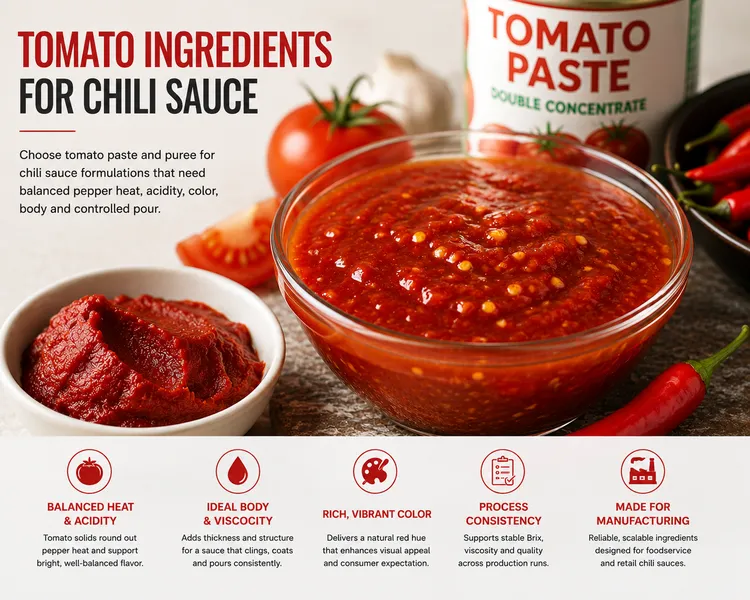
Choose a tomato format for the role it must play: paste for concentrated solids and body, puree for a softer base texture and easier dilution, crushed or diced tomato for visible piece identity, or clarified concentrate for savory tomato depth with less pulp.
For this application, a logical first combination to evaluate is tomato paste and puree. Tomato paste can efficiently supply concentrated solids, color and tomato intensity, while puree can help create a smoother transition between a thick tomato base and the desired finished pour.
The ratio does not need to be fixed. A formula may use paste alone, puree alone or a combination depending on the required solids, flavor profile, processing method and economics. Treat the suggested combination as a formulation hypothesis rather than a rule: the best ingredient system is the one that reaches the finished-product target reliably and at an acceptable total cost.
Paste versus puree
Tomato paste is generally useful when the formulation needs to introduce tomato solids without adding excessive water. This can help a manufacturer reach target body or soluble solids efficiently while leaving room in the recipe for vinegar, pepper preparations and other liquid ingredients.
Tomato puree provides a less-concentrated tomato base and may be useful where a softer, more fluid texture is preferred. It can also simplify formulation when the sauce does not require the concentration delivered by paste.
In practice, the choice should be made through finished-product trials rather than by ingredient description alone. Concentration, finish, particle structure, viscosity behavior, color and flavor character can vary between suppliers and processing systems.
Balancing tomato and pepper character
The tomato base should support the intended pepper profile rather than overwhelm it. In a mild chili sauce, tomato flavor may be relatively prominent. In a hotter sauce, the tomato system may function more as a body and color platform for chili peppers, pepper concentrates, spices or fermented pepper ingredients.
Because sweetness, acidity and tomato solids can influence how heat is perceived, a supplier substitution may require more than a simple water adjustment. The pepper level, vinegar, sugar, salt and spice balance should be reviewed after the tomato system has been normalized.
Acidity and flavor balance
Acid provides brightness and helps distinguish chili sauce from heavier tomato condiments. Vinegar is common in many formulations, but the target acid profile depends on the product concept and processing requirements.
Tomato ingredients themselves contribute organic acids and flavor compounds, so differences between samples can shift the perceived sharpness or sweetness of the finished sauce. Analytical measurements such as pH should therefore be considered alongside sensory evaluation rather than used as the only basis for comparison.
Texture and desired pour
A useful chili sauce must meet the intended flow target across manufacturing, filling and consumer use. A sauce that looks correct immediately after mixing may become thicker after cooling, while another may lose structure under pumping or high shear.
Tomato insoluble solids contribute body and suspension, while soluble solids influence overall concentration. If the formula also contains starch, gums or other hydrocolloids, evaluate the complete system because tomato solids and added stabilizers can interact.
Useful measurements may include viscosity, Bostwick consistency or another plant-standard flow test. Measurements should be taken under repeatable conditions, including temperature and rest time, because sauce flow can change significantly as the batch cools.
Practical trial method
Bench trials should normalize tomato solids first, then tune water, peppers, acid and seasonings. Measure both hot and cooled viscosity because many sauces change structure during cooling. Use consistent sample temperature and conditioning time whenever possible so comparisons are meaningful.
- Define the finished-product target and identify the attributes that cannot change, such as color, heat level, acidity, viscosity, pour, fill weight or sensory profile.
- Collect current technical data, specifications and representative samples from each candidate tomato source.
- Record concentration or Brix and normalize tomato solids before comparing usage rates.
- Adjust added water so candidate ingredients are tested on a comparable tomato-solids basis.
- Run a controlled bench or pilot batch using the actual addition order, mixing intensity and process conditions as closely as practical.
- Measure relevant attributes such as Brix/solids, pH, viscosity or Bostwick, color, yield and sensory profile.
- Evaluate tomato flavor, pepper heat, acidity, sweetness, salt balance, spice character and aftertaste.
- Repeat measurements after the relevant thermal process and cooling cycle.
- Evaluate the sauce after the intended storage period or accelerated screening condition where appropriate.
- Document the approved supplier, specification, formulation assumptions and change-control triggers.
What to compare between samples
Supplier samples should be judged in the finished chili sauce rather than only as tomato ingredients. A paste or puree that looks darker, thicker or stronger on its own may behave differently once diluted and combined with peppers, vinegar, sweeteners and spices.
Useful comparison points include normalized tomato-solids usage, finished yield, hot and cooled flow, visual color, tomato intensity, interaction with pepper heat, overall flavor balance and any change in thickener or water requirement.
Processing considerations
Addition order, heating rate, hold time and shear can change the way the finished sauce develops. For example, high shear may alter perceived body, while prolonged heating can influence color and cooked flavor.
Pilot work should therefore reproduce the production process as closely as practical. When scaling from bench to plant, document mixer type, agitation, temperature profile and holding conditions so formulation and processing effects can be separated.
Questions to ask the supplier
- What product definition, concentration, process and crop/origin apply to this lot?
- What Brix or soluble-solids range is specified?
- What finish, viscosity or particle characteristics are controlled?
- Which color parameters are guaranteed or routinely monitored?
- Which parameters are guaranteed versus typical?
- What sensory or defect criteria are included in the specification?
- What is the pack configuration, net weight and storage guidance?
- What shelf life applies under the recommended storage conditions?
- Which food-safety, quality and organic documents are available for this program?
- How are lots identified and traced?
- What changes in origin, process, specification or packaging require customer notification?
Commercial evaluation
Once technical performance is acceptable, compare candidates on a delivered finished-product basis rather than purchase price alone. Concentration influences how much tomato ingredient is required, how much water enters the recipe and how many finished units can be produced from a given quantity.
Also consider freight, pack efficiency, minimum order quantities, storage, inventory requirements and whether a particular tomato ingredient changes the required amount of thickener, color adjustment or other formulation components.