
Why this matters
Tomato ingredients can play several roles in curry sauce: they provide solids, acidity, color, body and a savory-sweet foundation that can support spices, chile, garlic, ginger and aromatics. Their effect depends on the curry style and on how much tomato character is intended to remain in the finished sauce.
Sauce performance is controlled by the interaction of tomato insoluble solids, soluble solids, water, acid, oil or other fats, spices, salt and thermal or shear history. A small change in tomato concentration, finish or process style can alter yield, viscosity, oil separation and sensory balance.
Define the curry style first
Curry sauce is a broad category. Some products are strongly tomato-led, while others use tomato mainly as a supporting base beneath spice, coconut, dairy, onion or other flavor systems.
Defining the intended style before selecting the tomato ingredient helps establish the appropriate level of tomato solids, acidity and color without unintentionally muting or dominating the spice profile.
Tomato paste for concentrated solids
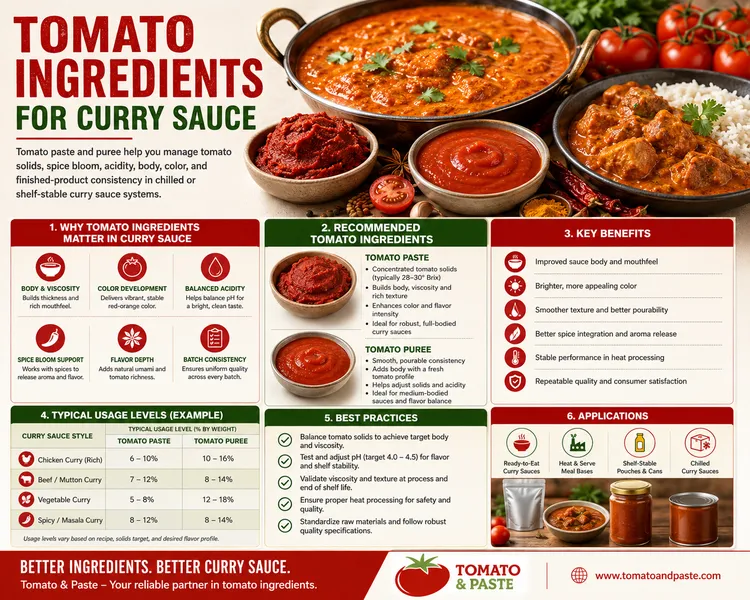
Tomato paste is useful where the sauce needs concentrated tomato flavor, red color and additional body without a large water contribution. It can help build a robust base for strongly seasoned curry sauces.
Higher paste inclusion can also make the sauce heavier and more tomato-forward, so the target should be balanced against spice intensity, fat level and desired eating texture.
Tomato puree for a softer base
Tomato puree can provide a smoother continuous sauce phase and a less concentrated tomato impression than paste alone. It can be useful where the curry needs fluidity or where tomato should blend more gently with spices and aromatics.
Because puree contributes more water, it should be evaluated together with coconut milk, cream, stock, vegetable puree or any other liquid components in the formula.
Combine paste and puree
A paste-and-puree system can give the formulator more control than either format alone. Paste provides concentrated solids and color, while puree can soften the texture and make the sauce easier to pump, fill and portion.
The preferred ratio should be determined after solids normalization and testing with the complete spice and fat system.
Normalize tomato solids
Candidate tomato ingredients should be compared on an equivalent tomato-solids basis whenever concentration differs. Equal usage rates can be misleading because one product may contribute substantially more water and less tomato solids than another.
Normalize tomato solids first, then adjust process water and the paste-to-puree ratio. This creates a more reliable comparison of viscosity, color, flavor and finished yield.
Spice bloom and tomato timing
Many curry systems develop flavor by heating spices in oil or another fat phase before additional liquids are introduced. Tomato addition can change that environment by introducing water, acid and solids.
Trials should reproduce the actual addition sequence because adding tomato earlier or later can change spice aroma, cooked flavor and the overall integration of the sauce.
Interaction with oil and fat
Oil, coconut fat, dairy fat or other lipid components can carry spice aromas and affect mouthfeel. Tomato solids influence how that fat is distributed throughout the sauce.
Evaluate the finished product for visible oil separation, particularly after thermal processing, chilled storage or reheating. Some oil separation may be stylistically acceptable in certain products, but the commercial target should be defined clearly.
Acidity
Tomato contributes natural acidity, which can brighten spice flavors but may become too sharp when combined with additional acids or highly acidic ingredients.
Evaluate both analytical pH and perceived acidity in the finished sauce. Spice, fat, salt and sweetness can all change how acidity is perceived, even when pH is similar between trials.
Sweetness and flavor roundness
Natural tomato soluble solids can help round bitter, hot or highly aromatic spices. Additional sugar, fruit, caramelized onion or coconut ingredients may further shift that balance.
Sensory trials should assess whether the tomato ingredient supports the spice profile without making the finished curry unnecessarily sweet or overly tomato-forward.
Chile and heat perception
Tomato solids and natural sweetness can change perceived chile heat. A higher tomato contribution may make the sauce feel rounder or soften the perception of sharp heat even when the chile dosage is unchanged.
Evaluate heat onset, intensity, persistence and aroma in the complete formula rather than judging chile components independently.
Color
Tomato paste and puree can create a red or orange-red foundation that combines with turmeric, paprika, chile, browned onion and other spices. The final shade depends on both tomato color and the surrounding spice system.
Evaluate color after full thermal processing and storage because extended heating can deepen both tomato and spice tones.
Viscosity and coating
Curry sauce may need to coat protein, vegetables, rice or other components while remaining fluid enough for filling and consumer serving. Tomato pulp contributes to body alongside starches, vegetable purees and other texture systems.
The target should reflect the actual application: a pour-over curry sauce may need more flow than a ready-meal sauce designed to remain around solid components during storage and reheating.
Hot and cooled viscosity
Many curry sauces change structure as they cool, particularly when starches, coconut ingredients, dairy components or tomato paste are present. A sauce that is fluid during cooking may become considerably thicker after filling.
Measure viscosity or Bostwick at standardized temperatures and include the final serving condition in product approval.
Free liquid and separation
Tomato pulp can help manage water in the continuous phase, but separation may still occur if the formula contains significant fat, vegetable moisture or unstable starch systems.
Evaluate serum and oil separation after a standardized hold period and again after the relevant thermal or storage cycle.
Interaction with coconut-based systems
Coconut milk or cream adds fat, water and characteristic flavor. Tomato concentration can influence both the color and perceived richness of these sauces.
Evaluate the actual coconut ingredient because fat content and solids can vary between formats and may alter finished viscosity and separation behavior.
Interaction with dairy-based systems
Cream, yogurt-style ingredients and other dairy components can soften tomato acidity and spice intensity while increasing richness. They also change the sauce's fat and protein environment.
Candidate tomato ingredients should be evaluated in the complete dairy-containing formula and after the intended heat process to confirm texture and sensory performance.
Ingredient selection
Choose paste where concentrated tomato solids, color and body are priorities. Use puree where the sauce needs a softer texture, easier flow or more moderate tomato intensity.
For this topic, a logical first ingredient system to evaluate is tomato paste and puree. Treat that as a formulation hypothesis rather than a fixed rule. The best combination is the one that supports the intended curry style, spice profile, texture and total cost with reliable supply.
Practical trial method
Bench trials should normalize tomato solids first, then tune water, fat, spice, salt and any sweetening or acid components. Final approval should reproduce the actual spice addition, thermal process and storage condition.
- Define the target curry style, tomato intensity, spice profile, heat level, viscosity, color and acidity.
- Identify attributes that cannot change, such as spice blend, fat system, protein or vegetable components, package or process.
- Collect current technical data, certificates of analysis and representative tomato samples.
- Confirm Brix or solids, process type, consistency, color, pH/acidity and finish.
- Normalize tomato ingredients to equivalent tomato solids.
- Define the starting paste-to-puree ratio.
- Adjust process water so trials begin from a comparable solids basis.
- Run a controlled batch using the actual spice and fat system.
- Reproduce the commercial spice-bloom and tomato-addition sequence.
- Use representative mixing, shear, heating and hold conditions.
- Measure Brix/solids, pH, viscosity or Bostwick, color and finished yield.
- Evaluate oil separation and sauce uniformity after processing.
- Evaluate tomato flavor, spice aroma, chile heat, acidity, sweetness and overall balance.
- Repeat viscosity and sensory evaluation after cooling or chilled storage where applicable.
- Apply the intended shelf-stable, chilled or reheating cycle.
- Document the approved supplier, specification, paste-to-puree ratio and change-control triggers.
What to evaluate in the finished curry sauce
- Balanced tomato and spice character
- Appropriate chile heat
- Controlled acidity
- Stable sauce viscosity
- Good coating behavior
- Stable red, orange or brown color
- Controlled oil separation
- Minimal undesirable serum separation
- Repeatable pH, Brix and yield
- Stable flavor after storage or reheating
Shelf-stable curry sauces
Shelf-stable sauces may experience hot filling, pasteurization, retort or another validated preservation process depending on product design. These treatments can change spice aroma, tomato flavor, color and viscosity.
Final approval should therefore be based on the packaged product after representative thermal treatment and storage rather than only the freshly cooked sauce.
Chilled curry sauces
Chilled sauces can thicken during storage and may show changes in oil distribution or spice perception over time. The product should be evaluated throughout the intended refrigerated shelf life.
Where the sauce is intended for reheating, include the consumer or foodservice reheating method in final evaluation.
Ready-meal curry applications
When curry sauce is used in a ready meal, protein, vegetables, rice and other components can absorb or release moisture during storage and reheating.
Test the sauce with the complete meal because its final viscosity and flavor may differ substantially from the sauce tested alone.
Cost and formulation yield
Compare tomato paste and puree on equivalent tomato solids and finished-sauce yield rather than purchase price per kilogram alone. Paste may efficiently increase solids, while puree may simplify formulation where a softer base is preferred.
Total economics should also consider water adjustment, fat and starch interactions, processing losses, finished yield, rework and any changes in spice or texture-system requirements.
Questions to ask the supplier
- What product definition, process and crop/origin apply to each tomato ingredient?
- Is the product paste, puree or another tomato format?
- What Brix or tomato-solids range is guaranteed?
- Which consistency or Bostwick parameters are guaranteed versus typical?
- What color specification applies?
- What pH and acidity ranges are typical or guaranteed?
- What screen finish or particle-size specification applies?
- What process type applies to the paste or puree?
- Which microbiological parameters are included in the specification?
- What is the pack configuration, net weight and storage guidance?
- Which food-safety, quality and organic documents are available for the program?
- How are production lots identified and traced?
- What crop, plant, process or specification changes require customer notification?
Commercial takeaway
Tomato ingredients in curry sauce should support the spice and fat system while providing the required solids, acidity, color and body. Paste is useful for concentrated tomato structure, while puree can create a softer continuous phase.
Compare suppliers at equivalent tomato solids, reproduce the actual spice-bloom and cooking sequence, and evaluate the finished sauce after storage or reheating. This provides a stronger basis for flavor consistency, viscosity control, yield and long-term sourcing approval.