
Why this matters
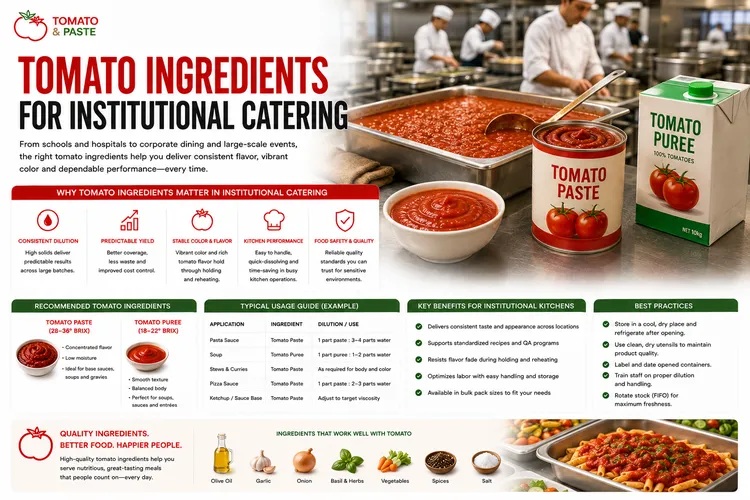
Institutional catering places different demands on tomato ingredients than small-batch restaurant preparation. Hospitals, schools, universities, workplace cafeterias, contract caterers and other high-volume kitchens may prepare large quantities from standardized recipes and depend on repeatable results across multiple cooks, shifts or locations.
Tomato ingredients must therefore combine consistent flavor and color with practical handling, predictable dilution and reliable yield. A relatively small difference in concentration, viscosity or water addition can become significant when multiplied across a large kettle or repeated across many service locations.
Design for repeatable bulk preparation
A strong institutional formula should be simple to scale and difficult to misinterpret. Tomato paste and puree are useful because they allow recipes to specify measurable ingredient weights and dilution ratios rather than relying on subjective reduction or cook-down.
The preferred ingredient should help kitchen teams produce comparable results whether the batch is made in a central commissary, satellite kitchen or institutional foodservice operation.
Foodservice tomato paste for concentrated solids
Tomato paste is a practical option where storage efficiency, concentrated tomato solids and controlled dilution are important. A relatively small amount can be reconstituted into a larger sauce, soup or cooking base using measured water or stock.
This can reduce the volume of tomato material that must be stored before use, but the recipe needs a clear dilution procedure. The paste should disperse readily and provide repeatable flavor and texture at the specified reconstitution level.
Tomato puree for easier preparation
Tomato puree may be preferable where the kitchen wants a more ready-to-use tomato base with less dilution and a softer texture. It can reduce preparation steps and may be easier to incorporate into soups, sauces, stews or braised dishes.
The tradeoff is that puree contributes more water and usually requires greater storage and handling volume than concentrated paste. The correct choice therefore depends on kitchen workflow as well as ingredient cost.
Combine paste and puree where useful
Some catering formulas benefit from using both paste and puree. Puree can establish the main sauce phase, while paste can increase tomato solids, color and body without requiring long kettle reduction.
This combination can be useful when a recipe needs straightforward preparation but still requires tighter control over final consistency and yield.
Standardize dilution
Dilution is one of the most important controls when concentrated tomato paste is used in large kitchens. Water or stock should be measured by weight or another defined method whenever possible rather than added according to visual judgment alone.
Even modest dilution variation can change tomato intensity, salt perception, sauce thickness and finished yield. Written recipes should state both the tomato ingredient quantity and the required liquid addition.
Normalize tomato solids
Supplier samples should be compared on an equivalent tomato-solids basis when their Brix or concentration differs. Comparing the same weight of two pastes can be misleading if one contains more tomato solids and less water.
Normalize solids first, then calculate the required dilution and compare flavor, color, consistency, yield and cost in the finished institutional recipe.
Batch scaling
Institutional formulas may need to move between different kettle sizes or serving volumes. Scaling should preserve the ratio of tomato solids, water, seasoning and other ingredients rather than relying only on nominal batch volume.
Verify that mixing and heating remain adequate at larger scale because a formula that disperses easily in a small pilot kettle may require a different addition sequence or mixing time in production.
Mixing and dispersion
Concentrated tomato paste should be dispersed uniformly before the finished sauce is evaluated. Poor dispersion can create local pockets of high solids, uneven color or inconsistent seasoning.
Depending on the equipment, the paste may be blended with part of the water or stock before the remaining ingredients are added. The most practical method is the one that kitchen staff can reproduce consistently.
Consistency and service behavior
Institutional tomato bases may be served as sauces, incorporated into soups and stews or used as building blocks for multiple recipes. The target viscosity should therefore reflect the final application rather than the tomato concentrate alone.
A sauce that is too thick may be difficult to portion or pump, while a sauce that is too thin can create inconsistent plate coverage and yield. Record consistency under defined temperature conditions where repeatability matters.
Hot holding
High-volume foodservice products may remain in steam tables, kettles or hot-holding equipment before service. During this time, water can evaporate and the sauce may become progressively thicker.
Evaluate viscosity, color and flavor after a representative hot-hold period. The tomato system should remain acceptable without excessive concentration, skin formation or separation under the intended service conditions.
Cooling and reheating
Some institutional kitchens prepare components in advance, chill them and reheat them for later service. Tomato bases can change viscosity during cooling, while reheating may alter water distribution and flavor intensity.
Where cook-chill operation is part of the program, include the complete cooling, storage and reheating sequence in validation rather than judging only the freshly prepared batch.
Color consistency
Tomato ingredients provide a recognizable visual standard across institutional menus. Stable color is particularly useful where the same base may be used across multiple locations or production days.
Evaluate finished color after the actual cooking and holding process because extended heat exposure can deepen the tomato shade.
Flavor consistency
Institutional menus often depend on standardized flavor profiles that should remain consistent regardless of operator or kitchen. Tomato paste and puree should therefore be evaluated for repeatable tomato intensity, acidity and cooked flavor.
Supplier changes should be tested within the complete recipe because differences in tomato flavor can alter the perception of salt, herbs, spices and savory ingredients.
Ingredient selection
Use paste where concentrated solids, compact storage and measured dilution are priorities. Use puree where the kitchen benefits from a more ready-to-use tomato base with fewer preparation steps.
For this topic, a logical first ingredient system to evaluate is foodservice tomato paste and puree. Treat that as a practical starting point rather than a fixed rule. The best ingredient is the one that delivers consistent preparation, flavor, texture and yield at an acceptable total operating cost.
Practical trial method
Trials should reproduce institutional batch size, kitchen equipment and service conditions as closely as practical. The objective is not only to confirm tomato quality but also to prove that the ingredient can be used consistently by real kitchen teams.
- Define the finished-product target for tomato flavor, color, viscosity, yield and serving application.
- Identify the intended kitchen environment, kettle size, batch size and service method.
- Collect current technical data, certificate of analysis and representative samples from each tomato candidate.
- Confirm Brix or solids, consistency, color, pH/acidity, process type and pack format.
- Normalize tomato solids before comparing supplier samples.
- Calculate a standardized dilution ratio for each candidate.
- Run a controlled batch using the actual kitchen equipment or representative pilot equipment.
- Use the real ingredient addition order and mixing method.
- Record exact tomato, water or stock and seasoning weights.
- Measure Brix/solids, pH and consistency where relevant.
- Record total finished yield.
- Evaluate tomato flavor, color, seasoning balance and texture immediately after preparation.
- Evaluate again after the expected hot-hold period.
- Where relevant, chill and reheat using the intended institutional process.
- Repeat the recipe with a second operator to confirm that instructions are sufficiently clear.
- Document the approved supplier, specification, dilution ratio and change-control triggers.
What to evaluate in institutional use
- Simple and repeatable dilution
- Consistent batch yield
- Reliable sauce or soup body
- Stable tomato color
- Balanced tomato flavor
- Minimal separation during holding
- Acceptable hot-hold viscosity
- Easy pumping, ladling or portioning
- Stable cooling and reheating performance
- Repeatable results across operators and kitchens
Foodservice pack format
Pack size should match kitchen throughput and handling practices. Large packs may reduce packaging per kilogram but can be less convenient where daily usage is limited, while smaller packs can improve portion control and reduce open-product handling.
Evaluate net weight, opening method, product removal, residual product in the pack, storage space and handling requirements as part of the commercial decision.
Central kitchens and commissaries
Central kitchens may use tomato paste or puree to prepare large standardized sauce bases that are then distributed to satellite locations. In this model, lot consistency and yield control become particularly important because one batch may support many meals or outlets.
The tomato base should tolerate pumping, chilling, transport and reheating if those steps are part of the operating model.
Multi-site consistency
Institutional catering programs may need the same recipe to perform across multiple locations with different staff and equipment. A robust tomato system should therefore tolerate normal operational variation without producing major changes in flavor or texture.
Clear written dilution ratios, batch weights and process limits help reduce operator-dependent variability.
Cost and usable yield
Compare tomato ingredients based on equivalent solids and finished usable yield rather than purchase price per kilogram alone. More concentrated paste may carry a different unit price but can produce substantially more finished tomato base after controlled dilution.
Total operating cost should also consider labor, storage space, packaging disposal, preparation time, waste, freight and the cost of correcting inconsistent batches.
Questions to ask the supplier
- What product definition, process and crop/origin apply to this lot?
- Is the ingredient paste, puree or another foodservice tomato format?
- What Brix or tomato-solids range is guaranteed?
- Which consistency parameters are guaranteed versus typical?
- What color specification applies?
- What pH and acidity ranges are typical or guaranteed?
- What screen finish or particle-size specification applies?
- What pack sizes and foodservice configurations are available?
- What is the net weight and recommended storage condition?
- What guidance applies after opening?
- Which microbiological parameters are included in the specification?
- Which food-safety, quality and organic documents are available for the program?
- How are production lots identified and traced?
- What crop, plant, process or specification changes require customer notification?
Commercial takeaway
Tomato ingredients for institutional catering should make high-volume preparation more predictable, not more complicated. Foodservice paste can deliver concentrated solids with efficient storage, while puree can simplify preparation where less dilution is preferred.
Compare suppliers at equivalent tomato solids, establish standardized dilution instructions and evaluate performance through cooking, holding and reheating. This provides a stronger basis for consistent meals, controlled yield and reliable multi-site foodservice programs.