
Why this matters
Meatballs in tomato sauce combine two components that continue to influence each other during cooking, filling, storage and reheating. The sauce must provide sufficient body to coat the meatballs, while remaining fluid enough for pumping and portioning. At the same time, moisture and fat released from the meatballs can change the sauce after processing.
Tomato ingredients in prepared foods must perform through pumping, filling, cooking, chilling, freezing or retort, storage and consumer reheating. An apparently small change in tomato solids, finish, particle size or process history can alter yield, sauce cling, sensory profile and the amount of water or thickener required.
Build the tomato system by function
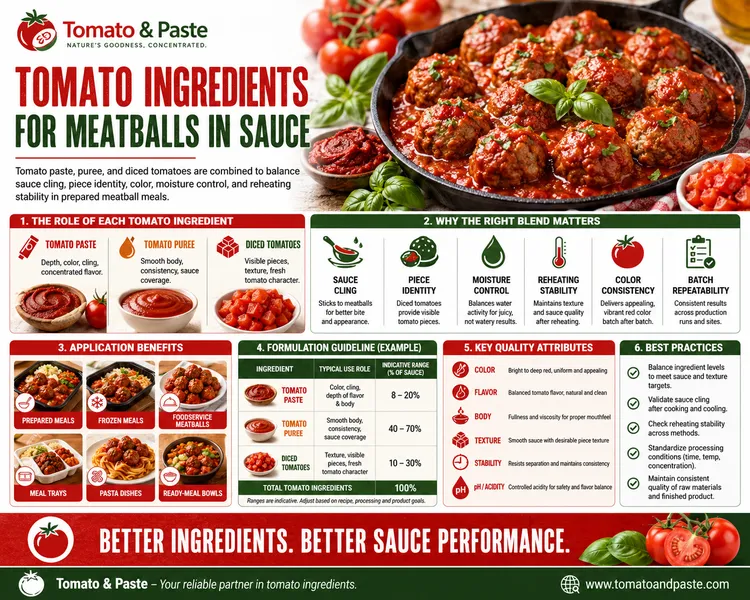
A combination of tomato formats often gives the formulator more control than a single ingredient. Tomato paste can provide concentrated solids and body, puree can create a smooth continuous sauce phase, and diced tomato can provide visible tomato character where the product concept requires it.
The correct ratio depends on whether the target is a smooth institutional sauce, a family-style retail meal, a rustic chilled product or another prepared-meal format.
Tomato paste for body and cling
Tomato paste is useful where the sauce needs concentrated tomato solids and enough structure to remain on the surface of the meatballs. It can increase tomato intensity, color and body without introducing as much water as less concentrated tomato ingredients.
The target is not simply maximum viscosity. Sauce that is excessively thick can become difficult to pump, fill and distribute evenly throughout the package. Trials should therefore balance cling with practical plant handling.
Puree for the continuous sauce phase
Tomato puree can soften the texture of a paste-heavy formulation and create a smoother surrounding sauce. It can also help distribute herbs, spices, oil and other seasonings around the meatballs.
A paste-and-puree combination can be particularly useful when the sauce needs enough body for coating but should still flow easily during filling and reheating.
Diced tomato for visible identity
Diced tomato can add a more recognizable culinary appearance to prepared meatball meals. The preferred size depends on the product concept, package, filling equipment and desired eating texture.
Dice integrity should be checked after pumping, mixing and thermal processing. Pieces that look acceptable in the incoming ingredient can soften or fragment during commercial handling.
Normalize tomato solids
Candidate tomato ingredients should be compared on an equivalent tomato-solids basis whenever concentration differs. Equal usage rates can create misleading results if one paste or puree contributes substantially more water than another.
Normalize the tomato-solids contribution first, then adjust water and the relative paste-to-puree ratio. This helps separate genuine differences in viscosity, flavor, color and processing behavior from simple concentration differences.
Cling around the meatball
Sauce cling affects both package appearance and eating quality. The sauce should coat the meatball rather than immediately draining away, but it should also redistribute when the product is stirred or reheated.
Tomato pulp contributes to this behavior alongside starches, gums and other texture systems. The meatball surface itself also matters: fat release, protein structure and surface roughness can influence how effectively the sauce adheres.
Moisture migration
Moisture can move between meatballs and sauce during cooking and storage. Meatballs may release water or absorb part of the sauce phase depending on formulation, cooking history and storage conditions.
This means sauce viscosity should not be approved only before filling. Evaluate the complete meal after the intended hold time, chilled or frozen storage period and reheating method.
Fat release and separation
Meatballs may release fat during cooking or reheating. That fat enters the tomato sauce and can affect appearance, mouthfeel and perceived viscosity.
Check for visible oiling-off, fat pools or separation around the meatballs. The tomato base, starch system, emulsification conditions and meatball formulation all contribute to final stability.
Color and finished appearance
Tomato paste and puree establish the primary red color of the sauce, while diced tomato can add visual variation. The final appearance should be evaluated after thermal processing because heat and fat can change the apparent shade and brightness.
The sauce should also provide enough coverage to make the meal look consistent without obscuring the identity of the meatballs or any other visible components.
Flavor balance
Tomato flavor must work with the meatball seasoning rather than compete with it. Garlic, onion, herbs, spices, cheese, meat flavors and fat all affect how tomato acidity and sweetness are perceived.
Sensory trials should therefore use the complete meal. Evaluate tomato intensity, savory balance, acidity, sweetness, herbs, meat flavor and aftertaste after the intended thermal process and reheating method.
Hot and reheated viscosity
The sauce may behave differently immediately after production, after chilled storage and after consumer reheating. Starches and hydrocolloids may continue to hydrate, while meatball moisture and fat can migrate into the tomato phase.
Use consistent temperature conditions when measuring viscosity or Bostwick and include a reheated measurement when that reflects actual consumer use.
Ingredient selection
Use higher-body ingredients where separation or weak cling is a concern; combine paste with puree or pieces where both sauce body and recognizable tomato texture are required.
For this topic, a logical first ingredient system to evaluate is paste, puree and diced tomatoes. Treat that as a formulation hypothesis rather than a fixed rule. The best answer is the combination that meets the finished-product target for cling, texture, flavor and process stability at an acceptable total cost and with reliable supply.
Practical trial method
Pilot the complete sauce-and-meatball system through the relevant thermal and storage cycle. Evaluate separation, meatball integrity, sauce coverage, color, flavor and viscosity after the same or representative hold time used in commercial production.
- Define the finished-product target for sauce cling, tomato texture, meatball-to-sauce ratio, color and flavor.
- Identify attributes that cannot change, such as meatball formulation, package, thermal process, label declaration or sauce portion weight.
- Collect technical data, certificates of analysis and representative samples from each tomato candidate.
- Confirm Brix or solids, consistency, process type, color, pH/acidity, finish and dice size where relevant.
- Normalize tomato solids before comparing candidate usage rates.
- Define the starting paste-to-puree-to-dice ratio.
- Adjust process water so each trial begins from a comparable solids basis.
- Run a controlled bench or pilot batch using the actual seasoning system and addition order.
- Use representative mixing, pumping, filling and holding conditions.
- Measure sauce Brix/solids, pH, viscosity or Bostwick, color and batch yield.
- Add or fill with the actual meatballs using the intended sauce-to-meatball ratio.
- Apply the relevant cooking, pasteurization, chilling, freezing or retort process.
- Evaluate sauce cling, free liquid, fat separation and meatball integrity after processing.
- Evaluate flavor, color and texture after representative storage.
- Repeat after the intended consumer or foodservice reheating method.
- Document the approved suppliers, specifications, ingredient ratios and change-control triggers.
What to evaluate in the finished meal
- Consistent sauce coverage on meatballs
- Appropriate cling without excessive thickness
- Controlled serum or water separation
- Minimal undesirable fat separation
- Stable meatball texture and integrity
- Appropriate diced tomato integrity where used
- Balanced tomato and meat flavor
- Stable red color after heating
- Repeatable sauce-to-meatball ratio and yield
- Acceptable reheating performance
Chilled prepared meals
Chilled meatball meals should be evaluated throughout the intended refrigerated shelf life. Sauce viscosity and water distribution can change as the tomato system, meatballs and any starches continue to equilibrate.
A sauce that appears ideal immediately after production may become thicker, thinner or more separated after several days. Reheating should therefore be included in the shelf-life evaluation.
Frozen prepared meals
Freezing introduces an additional stress on the sauce system. Water may redistribute during freezing and thawing, potentially affecting serum separation, diced tomato texture and sauce cling.
Evaluate the complete meal after representative frozen storage and the intended reheating cycle, not only before freezing.
Retort and shelf-stable formats
Retort processing can soften both tomato pieces and meatballs while also changing sauce viscosity and tomato flavor. Candidate ingredients should therefore be assessed after the complete scheduled process or representative pilot treatment.
Product-specific thermal-process validation remains essential. Tomato pH and solids contribute to the formulation but do not replace validation of the complete packaged meal.
Cost and formulation yield
Compare tomato ingredients on equivalent solids and finished-meal performance rather than purchase price per kilogram alone. Paste, puree and diced tomato each contribute different combinations of water, solids, texture and visual identity.
Total formulation cost should also consider sauce yield, thickener demand, filling losses, meatball-to-sauce portion control and any rework required to correct separation or texture. The best commercial combination is the one that delivers consistent performance at the lowest effective finished-product cost.
Questions to ask the supplier
- What product definition, process and crop/origin apply to each tomato ingredient?
- Is the product paste, puree, diced tomato or another tomato format?
- What Brix or solids range is guaranteed?
- Which consistency or Bostwick parameters are guaranteed versus typical?
- What color specification applies?
- What pH and acidity ranges are typical or guaranteed?
- What screen finish or particle-size specification applies?
- For diced tomatoes, what dice size and piece-integrity expectations apply?
- Which microbiological parameters are included in the specification?
- What is the pack configuration, net weight and storage guidance?
- Which food-safety, quality and organic documents are available for the program?
- How are production lots identified and traced?
- What crop, plant, process or specification changes require customer notification?
Commercial takeaway
Tomato ingredients for meatballs in sauce should be selected for the way the complete meal performs, not just for the incoming tomato specification. Paste can provide concentrated body, puree can establish a smooth sauce phase and diced tomato can add visible culinary character.
Compare suppliers at equivalent tomato solids, reproduce the real meatball-to-sauce ratio and evaluate the meal after processing, storage and reheating. This provides a stronger basis for consistent cling, appearance, flavor, yield and long-term sourcing approval.