
Why this matters
Pasta sauce can range from smooth and uniform to chunky, rustic and vegetable-rich. Tomato ingredients form the structural and sensory foundation of many of these products, contributing soluble and insoluble solids, color, acidity, tomato flavor and part of the finished viscosity.
Sauce performance is usually controlled by the interaction of tomato solids, water, acid, sugar, salt, oil, vegetables, herbs, spices, hydrocolloids and thermal or shear history. An apparently small change in concentration, finish, pulp structure or particle size can alter yield, pumping behavior, sensory profile and the amount of water or thickener required.
Build the tomato system by function
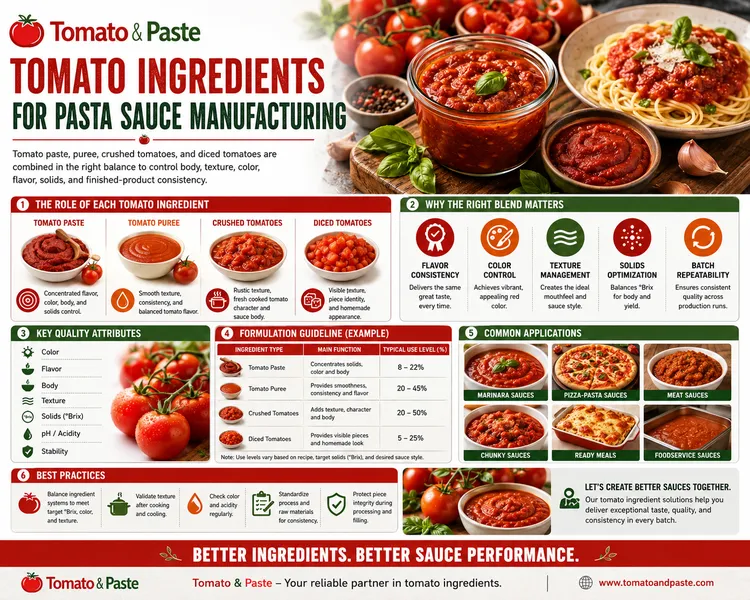
Different tomato formats can be used together because each contributes something different to the final sauce. Paste provides concentrated solids and body, puree creates a smooth continuous base, crushed tomato adds texture, and diced tomato provides visible piece identity.
Rather than asking which single tomato ingredient is best, formulators can define the role required from each component and adjust the ratio to achieve the desired style. This is particularly useful when developing smooth marinara, rustic tomato sauce, vegetable pasta sauce or premium chunky formats.
Tomato paste for concentrated body
Tomato paste can efficiently increase tomato solids, color and flavor without contributing as much water as less concentrated ingredients. It is useful for strengthening the sauce phase, increasing yield flexibility and controlling the amount of process water added separately.
Paste should not be selected on Brix alone. Process type, consistency, pulp structure, acidity, color and flavor can influence how much body the paste contributes and how it performs during cooking and storage.
Puree for a smooth base
Tomato puree can create a softer, more continuous tomato base than concentrated paste alone. It can help fill the spaces between vegetable pieces and provide a more natural sauce texture without requiring heavy dilution of a high-concentration paste.
The preferred puree level depends on the desired style. A smooth pasta sauce may use puree as a major component, while a thicker sauce may use puree together with paste to balance flow, body and tomato flavor.
Crushed tomato for culinary texture
Crushed tomato provides pulp and irregular tomato particles that can make pasta sauce appear more rustic and less highly processed. It also contributes to mouthfeel and can provide an intermediate texture between puree and diced tomato.
Particle distribution and screen finish matter. A finer crushed tomato can behave almost like a textured puree, while a coarser product creates more visible tomato structure.
Diced tomatoes for piece identity
Diced tomatoes are useful where visible tomato pieces are part of the product concept. Dice size and firmness should be selected according to the intended sauce style and the amount of processing the pieces will experience.
Pumping, mixing, cooking and filling can break down tomato dice, particularly after they soften. Piece integrity should therefore be assessed after the commercial process rather than only in the incoming ingredient.
Normalize tomato solids
Supplier comparisons should begin by normalizing tomato-solids contribution when the candidate products differ in Brix or concentration. Using equal ingredient weights can create misleading conclusions because one product may contain significantly more water than another.
Once equivalent solids are established, adjust process water and the ratio of paste, puree and crushed tomato. This provides a cleaner comparison of flavor, color, consistency, yield and total formulation cost.
Body and viscosity
Pasta sauce needs enough body to coat pasta and remain cohesive on the plate while still pumping and filling efficiently. Tomato insoluble solids contribute significantly to this structure, but the final viscosity also depends on added vegetables, oil, starches, gums and cook conditions.
Two tomato ingredients at similar Brix can produce different viscosity because of differences in pulp structure and process history. Measure consistency under controlled conditions rather than assuming that concentration alone predicts performance.
Hot and cooled viscosity
Many pasta sauces change structure as they cool. A sauce that appears relatively thin in the kettle may develop considerably more body after filling or cooling, particularly when starches or hydrocolloids are present.
Define the temperature at which viscosity or Bostwick is measured and use that condition consistently across trials. For products served hot, it can also be useful to evaluate the sauce at a representative consumption temperature.
Color and visual identity
Tomato ingredients are the primary source of red color in many pasta sauces. Paste can intensify the red base, while puree, crushed tomato and dice influence brightness, visual variation and perceived freshness.
Evaluate color after the full process and storage period. Heat exposure, oil, vegetables, herbs and spices can all change the way tomato color is perceived in the finished product.
Flavor balance
Pasta sauce typically combines tomato with garlic, onion, herbs, spices, oil and sometimes vegetables, meat or dairy. The tomato system needs enough flavor intensity to remain recognizable without overwhelming the desired seasoning profile.
Sensory trials should consider tomato intensity, sweetness-acidity balance, cooked flavor, bitterness, herb definition and aftertaste. Supplier changes can shift this balance even when nominal Brix remains similar.
Free liquid and separation
Excessive serum separation can make a pasta sauce look watery and can reduce coating performance on pasta. Tomato solids help create a cohesive sauce phase, but vegetable moisture, oil, starches and process conditions also influence separation.
If free liquid is a concern, evaluate the overall paste-puree-crushed ratio before simply increasing thickener. A stronger tomato-solids base may solve part of the problem while maintaining a more tomato-forward texture.
Vegetable and piece integrity
Pasta sauces containing diced tomato, onion, pepper, mushroom or other visible vegetables should be evaluated for piece integrity after mixing, pumping and heating. Excessive shear can convert a chunky sauce into a much smoother product.
Addition order can help protect delicate pieces. In some processes, it may be useful to establish the sauce base first and add more fragile vegetable components later in the mixing sequence.
Ingredient selection
Choose a tomato format for the role it must play: paste for concentrated solids and body, puree for base texture, crushed tomato for culinary texture, diced tomato for piece identity, or clarified tomato ingredients where a different soluble-solids profile is required.
For this topic, a logical first system to evaluate is paste, puree and crushed tomatoes, with diced tomato added where the finished product requires stronger piece identity. Treat that as a formulation hypothesis rather than a fixed rule. The best answer is the combination that meets the finished-product target at an acceptable total cost and with reliable supply.
Practical trial method
Bench trials should normalize tomato solids first, then tune water, seasoning and the relative contribution of paste, puree, crushed and diced ingredients. Measure hot and cooled viscosity because many sauces change structure during cooling.
- Define the finished-product target for sauce body, tomato flavor, color, particle texture and piece identity.
- Identify attributes that cannot change, such as label declaration, vegetable content, seasoning system, thermal process or pack format.
- Collect current technical data, certificates of analysis and representative samples from each candidate tomato source.
- Confirm Brix or solids, consistency, process type, color, pH/acidity, finish and particle size where relevant.
- Normalize tomato solids before comparing usage rates.
- Define the starting ratio of paste, puree, crushed tomato and diced tomato.
- Adjust process water to maintain a comparable total-solids basis.
- Run a controlled bench or pilot batch using the actual addition order and seasoning system.
- Use representative mixing, pumping, heating and holding conditions.
- Measure Brix/solids, pH, hot viscosity or Bostwick, color and final yield.
- Measure cooled consistency after a defined cooling or holding period.
- Evaluate tomato flavor, herb balance, acidity, sweetness and overall sensory profile.
- Check crushed and diced tomato piece integrity after processing.
- Evaluate free liquid or serum separation after a representative hold period.
- Repeat after the intended pasteurization, hot-fill, retort, chilled or frozen storage condition.
- Document the approved supplier, specification, ingredient ratio and change-control triggers.
What to evaluate in the finished sauce
- Target sauce body and coating behavior
- Consistent hot and cooled viscosity
- Balanced tomato intensity
- Stable red color
- Controlled free liquid
- Appropriate crushed tomato texture
- Acceptable diced tomato integrity
- Uniform herb and vegetable distribution
- Repeatable Brix, pH and batch yield
Cooked versus less-cooked styles
Some pasta sauces are designed around a strongly cooked tomato profile, while others aim for a fresher culinary character. Tomato selection and processing conditions should support the intended style.
Longer cooking can reduce free water and deepen flavor but may also soften pieces and change color. Less-intensive processing can retain fresher notes but may require tighter control of incoming tomato consistency and solids.
Hot-fill and shelf-stable sauces
Shelf-stable pasta sauces may experience substantial thermal treatment during cooking, filling, pasteurization or retort. The tomato system should maintain acceptable color, flavor and consistency through that process.
Approval should include the finished packaged sauce after representative thermal processing and storage, not simply the fresh kettle batch. Product-specific process safety and scheduled-process requirements remain the responsibility of the manufacturer.
Chilled and frozen pasta sauces
Chilled and frozen sauces should be evaluated after storage because water and solids can redistribute over time. Freeze-thaw conditions may also affect vegetable integrity and sauce consistency.
Where the sauce will be reheated by the consumer or foodservice operator, include the intended reheating method in the approval process.
Cost and formulation yield
Compare tomato ingredients on equivalent solids and finished-sauce performance rather than purchase price per kilogram alone. Paste, puree, crushed tomato and diced tomato each deliver a different combination of water, solids, texture and visual identity.
Total formulation cost should account for ingredient usage, added water, thickener requirements, yield, processing losses and any rework needed to reach the same target. A higher-priced tomato component can still provide better overall economics if it improves yield or reduces formulation correction.
Questions to ask the supplier
- What product definition, process and crop/origin apply to this lot?
- Is the product paste, puree, crushed tomato, diced tomato or another format?
- What Brix or solids range is guaranteed?
- Which consistency or Bostwick parameters are guaranteed versus typical?
- What color specification applies?
- What pH and acidity ranges are typical or guaranteed?
- What screen finish or particle-size specification applies?
- For diced tomato, what size and piece-integrity expectations apply?
- Which microbiological parameters are included in the specification?
- What is the pack configuration, net weight and storage guidance?
- Which food-safety, quality and organic documents are available for this program?
- How are production lots identified and traced?
- What crop, plant, process or specification changes require customer notification?
Commercial takeaway
Pasta sauce formulation benefits from treating paste, puree, crushed and diced tomatoes as separate tools rather than interchangeable ingredients. Paste can deliver concentrated body, puree can establish the base phase, crushed tomato can create culinary texture, and diced tomato can provide visible piece identity.
Compare suppliers at equivalent tomato solids, reproduce actual processing conditions and evaluate the finished sauce after the relevant thermal and storage cycle. This provides a stronger basis for repeatable texture, flavor, color, yield and long-term sourcing approval.