
Why this matters
Ratatouille and other vegetable stews contain ingredients that can release substantial moisture during cooking, storage and reheating. Tomato ingredients help turn that released liquid into a cohesive sauce while contributing color, acidity, flavor and solids.
Tomato ingredients in prepared foods must also perform through pumping, filling, cooking, chilling, freezing or retort, storage and consumer reheating. An apparently small change in solids, finish, particle size or process history can alter yield, sauce body, vegetable integrity and the amount of free liquid in the finished meal.
Crushed tomatoes versus puree
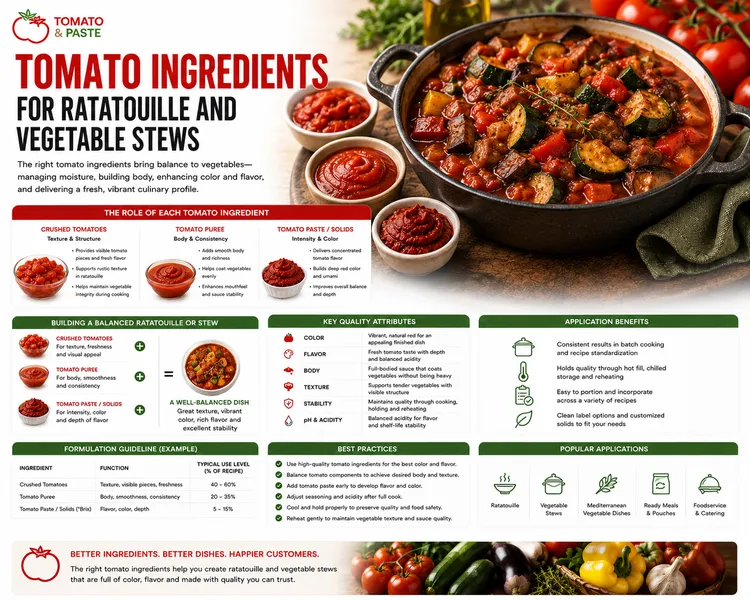
Crushed tomatoes are useful when the desired profile includes visible tomato texture and a more rustic sauce phase. Puree provides a smoother, more uniform background that can coat vegetables and distribute tomato flavor without adding large recognizable tomato pieces.
Many vegetable stews benefit from a combination of the two. Crushed tomato can provide culinary texture while puree fills the spaces between vegetables and helps create a continuous sauce phase.
Managing vegetable moisture
Eggplant, zucchini, peppers, onions and other vegetables can release water as they soften. The amount depends on vegetable variety, cut size, pre-cooking, salt level, thermal process and storage conditions.
The tomato system should contain enough solids to absorb and integrate this moisture without becoming overly concentrated. Where free liquid remains excessive, formulators may adjust the ratio of crushed tomato, puree or concentrated tomato ingredients rather than relying only on additional thickener.
Preserving a fresh culinary profile
Ratatouille-style products are often expected to retain a recognizable vegetable character. Tomato should support eggplant, zucchini, pepper, onion, herbs and olive-oil notes rather than overwhelming them with excessive concentrated or cooked tomato flavor.
Sensory evaluation should therefore consider tomato intensity alongside vegetable freshness, herb definition, sweetness-acidity balance and cooked flavor after the complete process.
Piece integrity matters
Vegetable identity depends heavily on piece integrity. Excessive shear during mixing, pumping or filling can break down softened vegetables and create a more homogeneous stew than intended.
The tomato base should provide enough lubrication and sauce coverage for processing while allowing the vegetable pieces to remain recognizable. Evaluate piece condition before processing, after thermal treatment and again after storage or reheating.
Solids and concentration
Tomato products with different Brix or solids levels should be normalized before direct comparison. A more concentrated product contributes more tomato solids and less water per kilogram, which can change both sauce body and the total water balance of the stew.
Compare candidates at equivalent tomato-solids contribution first, then tune the final crushed-to-puree ratio according to texture, flavor and moisture control.
Color and visual balance
Tomato provides the red base of many vegetable stews, but the finished appearance also depends on green zucchini, purple eggplant, peppers, onions and herbs. The tomato phase should provide enough color to look rich and cooked without visually masking the vegetable pieces.
Evaluate color after heating and representative storage. Long thermal treatment can deepen tomato color and soften vegetables, changing the visual balance of the finished product.
Acidity and seasoning
Tomato contributes natural acidity that can brighten cooked vegetables and balance oil or other rich ingredients. Differences in tomato pH, titratable acidity and solids may affect the amount of salt, herbs, sugar or other seasoning adjustment required.
Evaluate acidity together with the full seasoning system rather than as an isolated number. The target should support the culinary profile while remaining compatible with the intended processing and product specification.
Ingredient selection
Use higher-body tomato ingredients where free liquid is a concern; combine puree with crushed tomato or pieces when both a cohesive sauce base and recognizable tomato texture are required.
For this topic, a logical first ingredient system to evaluate is crushed tomatoes and puree. Treat that as a formulation hypothesis rather than a fixed rule. The best answer is the combination that meets the finished-product target for moisture control, piece definition, color and flavor at an acceptable total cost and with reliable supply.
Practical trial method
Pilot the full thermal and storage cycle. Evaluate free liquid, vegetable integrity, color, flavor and sauce consistency after the same or representative hold time used in commercial production.
- Define the finished-product target for vegetable piece size, sauce body, free liquid, color and flavor.
- Identify attributes that cannot change, such as vegetable ratio, label declaration, oil level, seasoning system, thermal process or pack format.
- Collect current technical data, certificate of analysis and representative samples from each candidate tomato source.
- Confirm tomato solids or Brix, particle size, consistency, color, pH/acidity and process type.
- Normalize tomato solids before comparing usage rates.
- Run a controlled bench or pilot batch using the actual vegetable cuts and ingredient addition order.
- Use representative mixing, pumping, heating and holding conditions.
- Measure Brix/solids, pH, sauce consistency or Bostwick, color and final yield where relevant.
- Evaluate free liquid after a defined hold period.
- Evaluate vegetable and tomato piece integrity after processing.
- Check tomato flavor, vegetable freshness, herb balance, acidity and overall sensory profile.
- Repeat the evaluation after the intended chilling, freezing, pasteurization or retort process.
- Evaluate again after representative storage and reheating.
- Document the approved supplier, specification, ingredient ratio and change-control triggers.
What to evaluate in the finished product
- Controlled free liquid
- Cohesive tomato sauce phase
- Recognizable vegetable pieces
- Acceptable piece integrity after heating
- Balanced tomato and vegetable flavor
- Fresh herb and seasoning definition
- Consistent red color without masking vegetables
- Stable texture after storage and reheating
- Repeatable finished yield
Process considerations
Addition order can influence vegetable integrity. Tomato puree or crushed tomato may be dispersed before more delicate cooked vegetables are added, reducing the amount of mixing those vegetables experience.
The most suitable sequence depends on the plant equipment and whether vegetables are raw, roasted, sautéed, blanched or otherwise pre-treated. Commercial trials should reproduce those conditions as closely as practical.
Chilled and frozen applications
In chilled or frozen ready meals, moisture can redistribute during storage. Vegetables may release additional water, while the tomato sauce phase may thicken or thin depending on the complete formulation.
Evaluate the product after storage and after the intended reheating method. The consumed product should still show appropriate sauce coverage, vegetable definition and moisture balance.
Retort and shelf-stable applications
Retort processing can further soften vegetables and deepen cooked tomato flavor. The tomato system should therefore be selected with the final post-retort texture in mind rather than only the fresh kettle result.
Product-specific thermal-process validation remains essential. Tomato pH and solids contribute to the overall formulation, but they do not replace validation of the complete packaged product.
Cost and yield considerations
Compare candidate ingredients according to equivalent tomato solids, usable yield and finished-product performance rather than purchase price per kilogram alone. A slightly higher-solids puree or crushed tomato may change the amount of added water or concentrated tomato required.
Total cost should also reflect any changes in process yield, thickener usage, free-liquid control or rework. The most economical tomato system is the one that reaches the intended culinary profile consistently with minimal formulation correction.
Questions to ask the supplier
- What product definition, process and crop/origin apply to this lot?
- Is the product crushed tomato, puree or another tomato format?
- What Brix or solids range is guaranteed?
- What particle-size or screen-finish specification applies?
- Which consistency parameters are guaranteed versus typical?
- What color specification applies?
- What pH and acidity ranges are typical or guaranteed?
- Which microbiological parameters are included in the specification?
- What is the pack configuration, net weight and storage guidance?
- Which food-safety, quality and organic documents are available for this program?
- How are production lots identified and traced?
- What crop, plant, process or specification changes require customer notification?
Commercial takeaway
Tomato ingredients in ratatouille and vegetable stews should support the vegetables rather than dominate them. Crushed tomatoes can provide visible culinary texture, while puree can build a more cohesive sauce phase and help integrate moisture released during cooking.
Compare suppliers at equivalent tomato solids, reproduce the actual thermal and handling conditions, and evaluate the finished product after storage and reheating. This provides a stronger basis for repeatable moisture control, piece integrity, flavor and yield.