
Why this matters
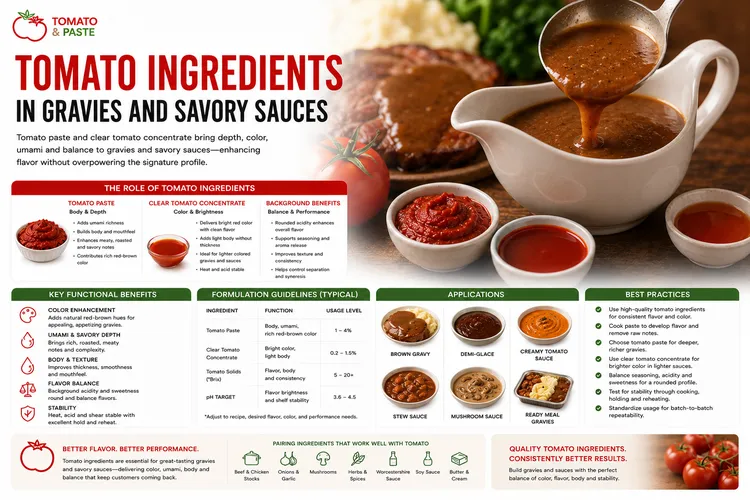
Tomato ingredients can play a supporting role in brown gravies, meat sauces, cooking sauces and other savory systems even when the finished product is not intended to taste primarily of tomato. At controlled inclusion levels, tomato solids can reinforce color, savory depth and background acidity while helping connect meat, stock, vegetable, spice and roasted flavor notes.
Sauce performance is usually controlled by the interaction of tomato insoluble solids, soluble solids, water, acid, salt, fat, proteins, starches or hydrocolloids and thermal or shear history. An apparently small change in tomato concentration, finish or process history can alter yield, viscosity, pumping behavior and the overall sensory balance.
Tomato as a supporting ingredient
In many gravies and savory sauces, the goal is not to create a recognizable tomato sauce. Instead, tomato is used at a restrained level to deepen the flavor base, reinforce cooked or roasted notes and contribute acidity that can brighten otherwise heavy savory systems.
The correct usage rate depends on the rest of the formulation. Meat stocks, yeast extracts, mushroom ingredients, browned vegetables, caramelized flavors, spices and fats can all change how strongly the tomato is perceived.
Tomato paste for body and depth
Tomato paste is useful when the formulation needs both tomato solids and physical body. Its insoluble pulp contributes structure, while its soluble components can reinforce savory and cooked flavor notes.
In darker gravies, relatively low usage rates may be enough to contribute depth without shifting the sauce toward a distinctly red tomato profile. The ideal level should be determined through sensory trials after the complete cooking process.
Clear tomato concentrate for less pulp
Clear or clarified tomato concentrate can be considered when the formulator wants tomato-derived soluble solids and savory character with less pulp contribution. This can be useful in sauces where smoothness, clarity or an existing starch system already provides the required body.
Because clear concentrate and conventional paste perform differently, they should not be treated as direct one-for-one substitutes. Compare them according to solids contribution, flavor impact, acidity, color and the effect on finished viscosity.
Managing color
Tomato can shift a gravy or savory sauce toward red, red-brown or warmer brown tones depending on usage rate and the rest of the formulation. This may be desirable where the objective is to reinforce roasted color, but excessive tomato color can move the finished product away from the intended visual identity.
Evaluate the final shade after cooking and storage rather than judging the tomato ingredient alone. Caramelized ingredients, stocks, soy-based components, fruit concentrates and spices can all interact with tomato color.
Background acidity
Tomato ingredients contribute natural acidity that can help balance fat, starch and rich savory flavors. At moderate levels, this acidity may improve flavor definition without creating an overtly sour impression.
Supplier-to-supplier differences in pH, titratable acidity and concentration can alter the final balance. When changing tomato sources, check whether salt, sweetness or other acid components require small adjustments.
Savory depth and umami perception
Tomato contains naturally occurring flavor compounds that can reinforce savory perception when combined with stocks, meat flavors, mushroom, onion, garlic and other seasoning systems. In a balanced formulation, tomato can make the overall sauce taste fuller without becoming the dominant identifiable flavor.
Sensory evaluation should focus on the total profile rather than simply asking whether the sauce tastes more or less of tomato. Check whether the tomato improves depth, balance and aftertaste while preserving the intended meat, vegetable or spice character.
Solids and concentration
Candidate tomato products should be compared on an equivalent-solids basis whenever concentration differs. A higher-Brix paste can deliver the same tomato-solids contribution at a lower usage rate, while a less concentrated product contributes more water to the formulation.
Normalize tomato solids first, then adjust water and seasonings. This allows a fairer comparison of body, flavor, color and total formulation cost between suppliers or tomato formats.
Interaction with starch and hydrocolloids
Many gravies rely on starch, flour, gums or other texture systems for their principal viscosity. Tomato pulp and soluble solids become part of that structure and can therefore change the amount or type of thickening required.
A paste with more inherent body may increase finished viscosity, while a clear tomato concentrate may contribute less pulp structure. Evaluate tomato ingredients within the real thickening system rather than in water alone.
Fat and emulsion systems
Gravies and savory sauces may contain oil, butter, dairy or rendered fat. Tomato acidity and solids can influence the way the sauce phase behaves around those ingredients, particularly during heating, holding and reheating.
Check for oiling-off, separation, graininess or uneven coating after the full process. Where emulsifiers or homogenization are used, reproduce those conditions during the trial.
Hot and cooled viscosity
Gravy structure can change considerably as the product cools, especially when starch systems are present. A sauce that seems thin in the kettle may become much thicker at serving temperature.
Measure viscosity under controlled temperature conditions and record both hot and cooled results where relevant. This helps prevent over-adjustment during production and makes supplier comparisons more repeatable.
Ingredient selection
Choose the tomato format for the role it must play: paste where solids and body are useful, puree for a softer tomato base, crushed or diced tomato where visible identity is required, or clarified concentrate where savory tomato contribution is wanted with less pulp.
For this topic, a logical first ingredient to evaluate is paste or clear tomato concentrate. Treat that as a formulation hypothesis rather than a fixed rule. The best answer is the ingredient that meets the target for flavor support, color, body and process performance at an acceptable total cost and with reliable supply.
Practical trial method
Bench trials should normalize tomato solids first, then tune water, salt, seasoning and thickening systems. Measure hot and cooled viscosity because many gravies and savory sauces change structure substantially during cooling.
- Define the finished-product target for color, savory intensity, viscosity, acidity and serving texture.
- Identify attributes that cannot change, such as meat or stock profile, thickening system, label declaration, thermal process or packaging format.
- Collect current technical data, certificate of analysis and representative samples from each candidate tomato source.
- Confirm Brix or solids, pH/acidity, color, consistency and whether the ingredient is conventional paste or clarified concentrate.
- Normalize tomato solids before comparing usage rates.
- Adjust process water so candidate trials begin from a comparable basis.
- Run a controlled bench or pilot batch using the actual ingredient addition order.
- Use representative mixing, shear, heating and hold conditions.
- Measure hot viscosity or Bostwick where relevant.
- Measure cooled viscosity after a defined cooling or holding period.
- Record Brix/solids, pH, color and final batch yield.
- Evaluate savory depth, tomato visibility, acidity, salt balance and aftertaste.
- Check for serum separation, oiling-off or other instability after processing.
- Repeat evaluation after the intended storage and reheating conditions.
- Document the approved supplier, specification, usage rate and change-control triggers.
What to evaluate in the finished sauce
- Savory depth without excessive tomato identity
- Appropriate red-brown or brown color
- Balanced background acidity
- Stable hot and cooled viscosity
- Good integration with meat, stock and spice flavors
- Minimal serum or fat separation
- Consistent coating and mouthfeel
- Repeatable solids and batch yield
Thermal processing and holding
Savory sauces may be cooked, hot filled, pasteurized, retorted, chilled or frozen depending on the application. Tomato flavor, color and viscosity can shift during each of these processes.
Long hot holds can intensify cooked flavor and change viscosity, while chilled storage can alter starch structure and water distribution. Approval trials should therefore include the same process sequence used in commercial production.
Cost and formulation yield
Compare tomato ingredients according to equivalent solids and their impact on the complete formula rather than purchase price per kilogram alone. A paste with more inherent body may reduce thickener demand, while a clarified concentrate may be preferable where the sauce already receives its structure from starch or other ingredients.
Total formulation cost should account for any changes in water, starch, seasoning or process adjustments required to achieve the same finished target. The most economical ingredient is the one that performs efficiently within the entire sauce system.
Questions to ask the supplier
- What product definition, process and crop/origin apply to this lot?
- Is the ingredient conventional tomato paste, puree or clarified concentrate?
- What Brix or solids range is guaranteed?
- Which consistency parameters are guaranteed versus typical?
- What color specification applies?
- What pH and acidity ranges are typical or guaranteed?
- What screen finish or degree of clarification applies?
- Which microbiological parameters are included in the specification?
- What is the pack configuration, net weight and storage guidance?
- Which food-safety, quality and organic documents are available for this program?
- How are production lots identified and traced?
- What crop, process, plant or specification changes require customer notification?
Commercial takeaway
Tomato ingredients can be highly effective in gravies and savory sauces even when tomato is not the dominant flavor. Paste can contribute both solids and body, while clear tomato concentrate can add soluble tomato character with less pulp.
Compare candidates at equivalent tomato solids, test them in the complete seasoning and thickening system, and evaluate the product after processing, storage and reheating. This provides a stronger basis for achieving repeatable savory depth, color, texture and formulation cost.