
Why this matters
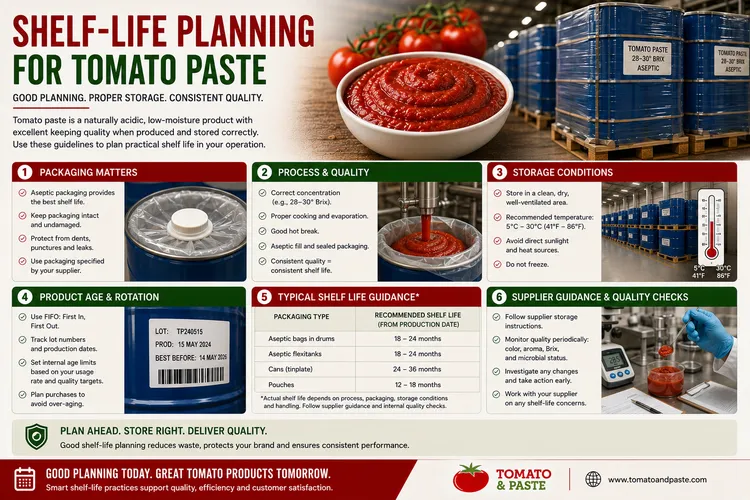
Shelf life is not determined by one number alone. Tomato paste performance over time depends on the product specification, manufacturing process, packaging system, storage conditions and the way the material is handled before use.
The specification remains the commercial translation of finished-product performance. Changes in Brix, consistency, color, acidity, finish or process history can influence how a paste performs in the factory and how its sensory and physical characteristics evolve during storage.
Ingredient selection
Start with solids or Brix and process type, then confirm consistency, color, pH or acidity, finish, microbiology, package type and lot documentation. Shelf-life planning should be tied to the exact commercial product rather than to tomato paste as a generic category.
For this topic, a practical starting point is aseptic and retail tomato paste. Treat the package type as part of the ingredient specification because drums, bins, cans, jars, pouches and other formats can have different storage and handling pathways.
Package type matters
Aseptic industrial paste is typically protected by a sealed sterile liner or bag within an outer drum or bin. Retail and foodservice formats may use cans, jars, pouches or other packages with different barrier and handling characteristics.
Shelf-life decisions should therefore reflect the exact package being purchased. Supplier guidance for one pack format should not automatically be applied to another without confirmation.
Supplier shelf-life guidance
Ask the supplier for the stated shelf life, recommended storage conditions and the basis used to identify the production or best-before period. Confirm whether the guidance applies from production date, filling date or another defined point.
The receiving plant should record this information in its item and lot-control system so remaining shelf life is visible when inventory is allocated to production.
Storage conditions
Store tomato paste according to the supplier's recommendations in a clean, dry environment appropriate to the package. Avoid unnecessary exposure to direct sunlight, standing water, excessive heat, freezing conditions or physical damage.
If a shipment or warehouse experiences conditions outside the normal storage program, document the event and assess the affected lot according to the plant's quality procedures.
Product age and lot rotation
Use a defined inventory-rotation system such as first-in, first-out or first-expired, first-out where appropriate. The objective is to avoid newer lots being consumed while older approved inventory remains unused.
Product age should be considered together with planned production dates, transit time and finished-product requirements. A shipment with less remaining shelf life may still be acceptable if it can be used within the approved period, but that decision should be deliberate.
Package integrity
Shelf-life planning assumes that the package remains intact. For aseptic drums and bins, inspect the outer container and accessible liner areas for leakage or damage. For retail or foodservice packages, check seams, closures, seals and obvious deformation as applicable.
Suspect packages should be placed on hold and reviewed rather than automatically treated as equivalent to undamaged inventory.
Color over storage
Color is an important commercial characteristic in many tomato applications. Product age, storage conditions and process history can influence the way color is perceived over time.
Where color is critical to the finished product, include it in incoming and shelf-life review. Compare stored samples under consistent preparation and lighting conditions.
Flavor and aroma
Shelf-life evaluation should include sensory review because tomato flavor and aroma can change over time even when the product remains within basic analytical specifications.
Evaluate the paste in the finished formulation where possible. A subtle change in the ingredient may be more or less noticeable after dilution, seasoning and thermal processing.
Brix, pH and consistency
Analytical checks such as Brix or solids, pH and consistency can help confirm that a stored lot remains aligned with the approved product profile. The relevant tests depend on the purchasing specification and finished application.
Use the same preparation and measurement methods at each review point so changes can be interpreted consistently.
Aseptic versus opened product
The supplier's shelf-life guidance for a sealed aseptic package should not be assumed to apply after the liner or package is opened. Once opened, the product is exposed to a different handling and microbiological environment.
Any partial-use, temporary holding or reclosure procedure should be specifically validated by the manufacturer within its own process and food-safety system.
Retail and foodservice packs
Smaller packs may have different distribution and storage pathways from industrial aseptic drums. Consider package barrier, closure integrity, warehouse conditions and the expected time between manufacture, distribution and final use.
If the product will be repacked, portioned or used after opening, define separate controls for the unopened and opened stages rather than relying on one shelf-life statement.
Planning with current-season and carryover inventory
Tomato paste production is crop-linked, so commercial programs may involve current-season material, inventory carried between processing seasons or a combination of both.
Buyers should understand production dates and remaining shelf life when scheduling purchases. Product age can be included as a commercial criterion alongside Brix, process type, pack format and price.
Practical shelf-life trial method
Run candidate ingredients in the actual formula at equal tomato solids whenever practical and evaluate both initial performance and agreed storage checkpoints.
- Define the tomato paste specification, package type, intended storage period and critical finished-product attributes.
- Collect current supplier technical data, shelf-life guidance and representative samples from each candidate source.
- Record production or pack date, ingredient lot, Brix or solids, process type and package condition.
- Normalize tomato solids before comparing candidate usage rates where concentrations differ.
- Run a controlled bench or pilot batch using the real addition order and representative process conditions.
- Measure relevant attributes such as Brix, pH, viscosity or Bostwick, color, yield and sensory profile.
- Store retained samples under the defined conditions and repeat the agreed analytical and sensory checks at planned intervals.
- Document any package changes, color shift, flavor drift, consistency change or other meaningful observations.
- Compare results with supplier guidance and the manufacturer's internal acceptance criteria.
- Document the approved supplier, specification, package, storage conditions and change-control triggers.
Shelf-life records
A useful shelf-life record connects the ingredient lot, storage condition and test result at every review point. Avoid relying on isolated sensory comments without the corresponding product age and storage history.
For commercial programs, retain enough information to understand whether a future issue is related to supplier lot, packaging, storage, product age or the finished-product process.
Commercial considerations
Shelf life can influence purchasing economics. Larger orders may reduce unit freight or improve availability, but they also increase inventory age and warehouse exposure if the material is not consumed quickly enough.
Compare purchase quantity, production schedule, transit time, remaining shelf life, warehouse capacity and expected usage together. The lowest purchase price is not necessarily the best outcome if inventory must be held longer than the approved storage plan.
Questions to ask the supplier
- What stated shelf life applies to this exact tomato paste specification?
- From which date is the shelf-life period calculated?
- What storage conditions are recommended?
- Does shelf-life guidance differ by drum, bin, can, pouch or other package?
- What Brix, process type and finish apply to the quoted product?
- Which quality parameters are guaranteed throughout the stated shelf-life period?
- Which parameters are guaranteed versus typical?
- How is production date or pack date shown on the lot code?
- What package conditions require quality review or rejection?
- Is current-season or carryover inventory being quoted?
- What documentation is available for lot release and traceability?
- Are retained samples or historical shelf-life data available for the product?
- What guidance applies after the package is opened?
- What storage, packaging or process changes require customer notification?