
Why this matters
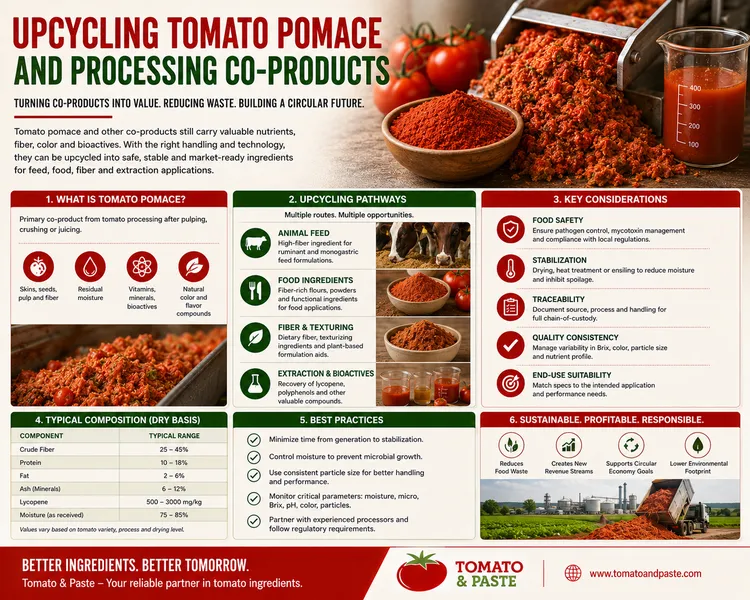
Tomato processing generates material streams beyond paste, puree and juice. Depending on the process, these can include skins, seeds, pulp-rich pomace and other separated solids. When these streams are properly identified, stabilized and qualified for an intended use, they may support feed, food, fiber or extraction applications rather than being treated only as residual material.
The commercial opportunity depends on more than availability. Moisture, composition, microbiological condition, particle profile, processing history, storage method and destination-market requirements can all affect whether a co-product is technically suitable and economically practical.
Define the co-product clearly
“Tomato pomace” can describe materially different products depending on the processor and separation process. One source may contain a high proportion of skins, another more seeds, and another a broader mixture of pulp and fibrous solids.
Before trialing any material, establish a clear product definition. Record the source process, expected composition, moisture or dry-matter range, particle size, any further milling or drying steps and whether other tomato-processing streams are blended into the product.
Ingredient selection
Separate must-have technical requirements from negotiable preferences. This creates alternate-source flexibility without compromising critical finished-product attributes.
For this topic, a logical first ingredient to evaluate is tomato pomace or a defined tomato fiber ingredient. Treat that as a formulation hypothesis rather than a fixed rule: the preferred product is the one whose composition, safety, functionality, process compatibility and delivered cost match the intended application.
Stabilization and moisture control
Fresh processing co-products may contain substantial moisture and can be more difficult to store or transport than stabilized dry ingredients. The route from generation to drying, cooling, packaging or other stabilization should therefore be understood before commercial use.
For dried materials, review moisture specifications and storage guidance. For higher-moisture products, evaluate shelf-life limitations, transport radius, temperature requirements and the time between processing and use.
Food applications
Where suitability is specifically established, processed tomato fiber or pomace-derived ingredients may be evaluated for applications where color, tomato identity, fiber contribution or texture are useful. Examples can include savory bakery products, sauces, seasonings or other formulated foods.
Food applications require a clearly defined ingredient, appropriate processing controls and documentation that support the intended use. A material generated as a co-product should not be assumed suitable for food merely because it originates from food-grade tomatoes.
Feed applications
Feed can be a practical pathway for some tomato-processing co-products where composition, safety and local regulatory requirements support the intended use. Moisture, fiber, seed content, storage stability and nutritional characterization can influence commercial value.
Buyers should define the target species, inclusion objective, physical form and delivery requirements before evaluating a source. The responsible feed manufacturer should determine nutritional suitability and compliance for the destination market.
Fiber-focused ingredients
Additional drying, milling, screening or separation can convert some pomace streams into more standardized fiber-rich ingredients. These may be easier to formulate than an untreated co-product because moisture and particle distribution can be more tightly controlled.
When evaluating a fiber ingredient, review its source definition, particle size, water-binding behavior, color and flavor contribution. The desired specification depends on whether the ingredient is intended mainly for functional texture, visible tomato character or dry-solids contribution.
Extraction pathways
Tomato skins, seeds and other fractions may also be considered as feedstocks for extraction or further processing where an economically viable downstream market exists. The value of such pathways depends on raw-material composition, concentration of the desired fraction, recovery efficiency and the cost of drying, transport and processing.
Extraction projects should therefore begin with representative compositional data and realistic mass-balance assumptions rather than relying only on theoretical value in the incoming co-product.
Particle size and physical form
Co-products may be supplied wet, dried, milled, granulated or otherwise processed. Physical form affects handling, mixing, storage density, dust generation and compatibility with downstream equipment.
Define the particle-size range needed for the intended process. A coarse fibrous material may be acceptable in some feed applications but unsuitable for a fine food formulation or extraction system without additional milling.
Color and flavor
Tomato pomace and fiber can carry noticeable red-orange color and tomato flavor, but the intensity depends on the composition of skins, seeds and residual pulp as well as drying conditions.
For food applications, assess both desirable tomato notes and any excessive bitterness, toasted notes or other sensory effects. Evaluate color and flavor in the finished product rather than approving the ingredient only from a dry sample.
Safety and suitability
Safety review should match the intended use. Important considerations can include the original tomato raw material, separation process, time and temperature before stabilization, drying controls, foreign-material management, storage and traceability.
The buyer should request technical and quality documentation appropriate to the application and should confirm that the supplier treats the material as a defined commercial ingredient rather than an uncontrolled waste stream.
Traceability and lot identity
Upcycled ingredients should retain a clear connection to the processing operation from which they originated. Lot coding should allow the supplier to identify relevant production dates, processing conditions and source records.
This becomes especially important when multiple production days, crops or processing streams are combined. Ask how lots are created and what information can be traced backward and forward if a quality issue arises.
Supply consistency
Tomato processing is crop-linked and seasonal, so co-product availability may be concentrated around processing campaigns. Buyers should understand whether the supplier produces the ingredient only during harvest or maintains stabilized inventory for year-round shipment.
Composition can also vary with crop, tomato variety, processing configuration and the proportion of skins, seeds and pulp in the stream. A workable commercial program therefore needs realistic specification limits and a plan for managing natural variation.
Logistics and landed cost
Moisture and bulk density can dominate the economics of co-product movement. A low-cost wet material may become expensive to ship over long distances, while drying and milling can increase ingredient value but also add processing cost.
Compare offers on landed usable dry matter, packaging efficiency, freight, storage requirements, process yield and continuity—not unit price alone. The most economical source is the one that delivers usable functionality at the required location and scale.
Practical trial method
Evaluate co-products using a structured qualification process that separates ingredient identity, safety and supply questions from formulation performance.
- Define the intended use and the critical attributes the co-product must provide.
- Obtain a clear product definition, source-process description and current technical specification.
- Review moisture or dry matter, particle size, composition, storage guidance and available quality documentation.
- Compare candidate materials on an appropriate dry-matter or usable-solids basis.
- Run a controlled bench or pilot trial using the intended addition order and process conditions.
- Measure application-relevant attributes such as water binding, texture, color, yield, particle integrity and sensory profile.
- Evaluate the product after the relevant thermal process and storage condition.
- Review packaging, transport, seasonality, minimum order quantities and expected annual availability.
- Document the approved supplier, product definition, specification and change-control triggers.
Supplier qualification
Supplier qualification should confirm that the co-product is deliberately managed as an ingredient with documented controls. Review the manufacturing site, process description, product specification, lot coding, storage practices and relevant food- or feed-safety documentation.
Also define which changes require customer notification. Changes in drying method, source process, composition, particle size or blending practice can materially affect the performance of a pomace-derived ingredient.
Commercial considerations
A successful upcycling program must work technically and economically. Consider processing cost, drying energy, milling, packaging, freight, inventory carrying cost, usable yield and the value delivered in the finished application.
Co-products can support waste-reduction and resource-efficiency goals, but sustainability benefits should not substitute for product suitability. The preferred pathway is one that combines a defined end use, controlled quality, viable logistics and repeatable commercial demand.
Questions to ask the supplier
- What is the exact product definition and source processing stream?
- What proportions of skins, seeds, pulp or other fractions are typically present?
- What crop and origin apply to the product?
- How quickly is the material stabilized after separation?
- What drying, milling, screening or other processing steps are used?
- What moisture or dry-matter range is specified?
- What particle-size specification applies?
- Which compositional parameters are guaranteed versus typical?
- How are microbiological, foreign-material and quality controls managed?
- What is the pack configuration, net weight and storage guidance?
- What shelf life applies under recommended storage conditions?
- Which food-safety, feed-safety, quality or organic documents are available for the intended program?
- How are lots identified and traced back to the processing operation?
- Is supply seasonal, campaign-based or available from year-round inventory?
- What process, composition or specification changes require customer notification?