
Why this matters
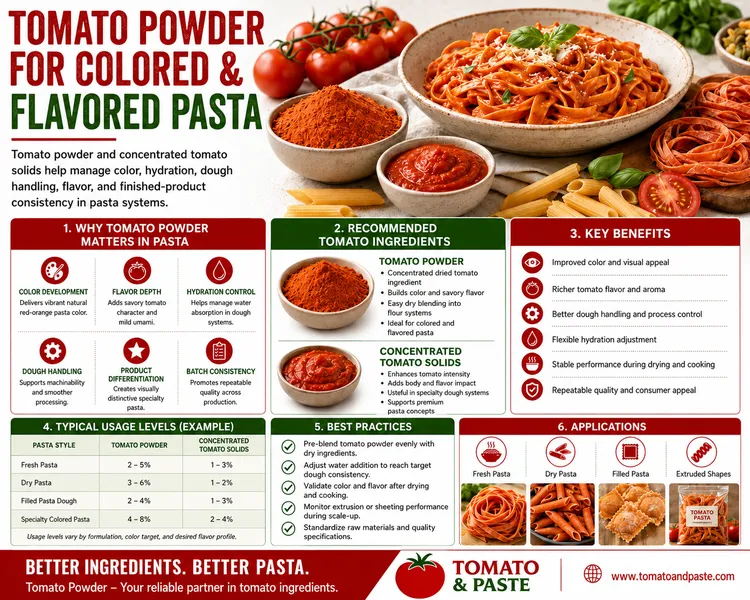
Dry tomato ingredients concentrate flavor and color without adding the water load of puree or paste, making tomato powder a practical option for colored and flavored pasta. In dough systems, however, moisture, particle size, dispersibility and dry-matter contribution become important because they can affect water demand, dough consistency and forming behavior.
A relatively small change in tomato-powder specification can shift the finished color, tomato intensity and hydration requirement. These changes may also influence mixing, extrusion or sheeting performance, drying behavior and cooked texture, so supplier samples should be evaluated through the complete pasta process rather than only as dry powders.
Ingredient selection
Select powder where uniform tomato color and flavor are desired throughout the dough. Granules or larger dried tomato particles may be suitable where a more visible inclusion is wanted, but they can behave differently during forming and drying.
For this topic, a logical first ingredient to evaluate is tomato powder. Treat that as a formulation hypothesis rather than a fixed rule: the preferred ingredient is the one that meets the target color, flavor, hydration, processing and cooked-quality requirements at an acceptable total cost and with reliable supply.
Hydration and water adjustment
Tomato powder contributes dry solids that interact with the flour or semolina system. Increasing the powder level may therefore require an adjustment to process water to maintain the desired dough consistency.
Water should be optimized against the complete formula rather than added according to a fixed replacement ratio. Flour characteristics, tomato-powder moisture, particle size, mixing time and the intended pasta format can all influence the amount of water required.
Dough handling
The dough should be evaluated for uniform hydration, cohesiveness and suitability for the forming process. An under-hydrated system may appear crumbly or difficult to form, while excessive water can produce a soft or sticky dough and create downstream drying challenges.
During trials, record actual water addition, mixing time and dough condition before extrusion or sheeting. Keeping these variables controlled makes supplier comparisons more meaningful.
Particle size and distribution
Fine tomato powder generally supports more uniform color distribution, while coarser material can create visible speckling. Either effect may be desirable depending on the finished-product concept.
Particle size can also influence hydration rate and distribution through the dough. Review supplier mesh or particle-size information and check whether visible particles interfere with dies, rollers or other forming equipment used for the intended pasta shape.
Color development
Tomato powder can produce orange-red tones in pasta, but the final appearance depends on the powder itself, inclusion rate, flour or semolina color, hydration and process conditions. Evaluate color at several stages rather than judging only the mixed dough.
The dried product and cooked pasta can differ noticeably from the fresh dough. For that reason, color approval should ideally include the commercially relevant dried and prepared states.
Flavor balance
Tomato flavor may be subtle or pronounced depending on usage rate and the base pasta formulation. Salt, herbs, spices, vegetable powders, egg ingredients and other components can change the way tomato character is perceived.
Evaluate the finished pasta after cooking because hydration and thermal exposure can change flavor intensity. A powder that appears strong in raw dough may produce a milder finished profile after drying and preparation.
Extrusion and sheeting
Tomato powder should be evaluated using the actual forming process wherever possible. Extruded pasta and sheeted pasta impose different mechanical conditions on the dough and may respond differently to changes in dry solids and water.
During extrusion, monitor dough feed, pressure, surface appearance and shape definition. During sheeting, observe elasticity, tearing, sticking and thickness consistency. Any significant change in tomato-powder specification should be checked against these process variables.
Drying performance
Drying is an important part of the final evaluation because it influences product stability, texture and appearance. Changes in dough hydration or solids can alter drying behavior even when the forming step appears acceptable.
Compare candidate formulas using the intended drying schedule and record final moisture, product integrity and visual color. If the pasta is sold fresh rather than dried, evaluate the relevant refrigerated or packaged shelf-life pathway instead.
Cooking quality
Finished pasta should be evaluated after the intended cooking method. Important observations can include cooking time, shape retention, firmness, surface condition and the degree to which color or flavor remains apparent after cooking.
If tomato-powder inclusion is increased substantially, confirm that the finished eating quality still meets the target. Ingredient performance should be judged on the prepared product rather than only on manufacturing convenience.
Practical trial method
Control powder addition, water adjustment and processing conditions. Compare candidate tomato powders through mixing, forming, drying and cooking so both processing behavior and finished-product quality are captured.
- Define the finished-product target, including pasta format, tomato intensity, color, cooked texture and appearance.
- Collect current technical data and representative samples from each candidate supplier.
- Review moisture, particle size, composition, color and any declared carriers or processing aids.
- Normalize tomato solids or dry matter before comparing candidate usage rates where appropriate.
- Run a controlled dough trial using the intended flour or semolina, addition order and mixing conditions.
- Adjust and record water addition until the target dough consistency is achieved.
- Evaluate extrusion or sheeting behavior, shape definition and process consistency.
- Dry or package the pasta using the intended commercial process and record final moisture and appearance.
- Cook the finished pasta and evaluate color, texture, flavor and shape retention.
- Document the approved supplier, specification, usage range and change-control triggers.
Storage and handling
Tomato powder should be protected from unnecessary moisture exposure before use. Moisture pickup can affect flowability and may make accurate dosing or blending more difficult.
Confirm the supplier's recommended storage conditions, shelf life and pack format. Where bags are partially used, plant procedures should minimize exposure and maintain clear lot identification for traceability.
Commercial considerations
Compare tomato powders on more than price per kilogram. Moisture, effective tomato-solids concentration, color strength, required usage rate, packaging, freight and processing consistency can all affect the true finished-product cost.
A powder that produces stronger color at a lower usage rate may offer a different cost outcome from a less concentrated alternative, but the final decision should also consider dough behavior, cooked quality, specification consistency, documentation and continuity of supply.
Questions to ask the supplier
- What is the exact product definition and tomato raw material used?
- What process and crop/origin apply to this lot?
- What moisture range is specified?
- What particle-size or mesh distribution applies?
- Does the powder contain carriers, processing aids or other declared components?
- How are color and flavor consistency monitored?
- What is the typical bulk density and flow behavior?
- Which parameters are guaranteed versus typical?
- What is the pack configuration, net weight and storage guidance?
- What shelf life applies under recommended storage conditions?
- Which food-safety, quality and organic documents are available for this program?
- How are lots identified and traced?
- What crop, process or specification changes require customer notification?