
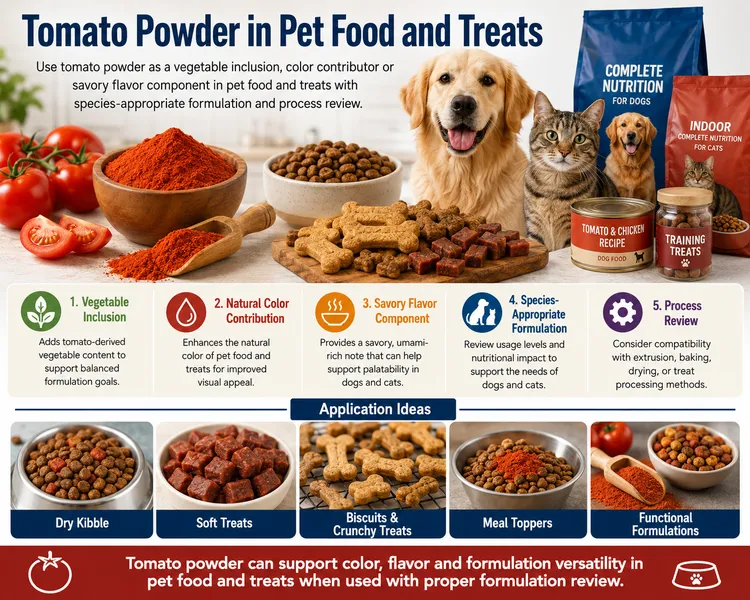
Why this matters
Tomato ingredients can contribute color, acid balance, savory depth and dry vegetable solids in pet food and treat formulations. Tomato powder is particularly useful where a dry ingredient is easier to meter, blend and store than a liquid puree or paste.
Even at relatively modest inclusion rates, differences in powder moisture, particle size, flavor intensity, color and processing history can influence the finished product. In dry or semi-moist systems, tomato powder can also affect water demand, dough handling, extrusion behavior and final texture, so it should be evaluated as part of the complete formula rather than as a simple flavor addition.
Ingredient selection
Match the tomato format to the manufacturing process. Paste or puree may suit wet foods and sauce systems, while powder can be practical for dry kibble, baked treats, seasoning systems and other formulations where additional liquid is undesirable.
For this topic, a logical first ingredient to evaluate is tomato powder. Treat that as a formulation hypothesis rather than a fixed rule: the preferred ingredient is the one that delivers the target appearance, flavor, processing behavior and dry-matter contribution at an acceptable total cost and with reliable supply.
Powder composition and specification
Tomato powders are not necessarily interchangeable. Review the product definition and specification carefully, including moisture, particle size, color, bulk density and any declared carriers or processing aids. These characteristics can influence both the effective tomato-solids contribution and the way the powder behaves during storage and production.
A free-flowing powder may be easier to handle in automated dosing systems, while a very fine powder can disperse quickly but may create more dust during transfer. The appropriate specification depends on the plant's equipment and the desired finished-product characteristics.
Color and savory profile
Tomato powder can contribute a recognizable red-orange tone and a mild savory tomato profile. The effect depends on inclusion rate and on the color and flavor of proteins, grains, fats, minerals and other ingredients in the formula.
Evaluate color after the full manufacturing process rather than only in the premix. Heat from baking, drying, retorting or extrusion can shift the appearance and perceived flavor of the finished product.
Hydration and moisture balance
Because tomato powder is a dry ingredient, it can interact with the formula's available water. A change in powder inclusion can therefore affect dough consistency, mixing behavior, shaping and final moisture even when the nominal recipe change appears small.
In products where texture is tightly controlled, evaluate whether additional process water or other formulation adjustment is required. The correct balance should be determined on the actual production process rather than inferred from powder appearance alone.
Interaction with proteins, starches and fats
Assess interactions with proteins, starches, fibers, minerals and fats. Tomato powder may influence the visual appearance and flavor of these systems, while other ingredients can change how strongly the tomato note is perceived.
In formed or baked treats, changes in dry solids can affect dough handling and fracture characteristics. In extruded products, the complete formulation and process conditions determine expansion, density and final texture, so candidate powders should be compared using the same controlled process.
Thermal processing
Thermal processing can change perceived acidity, savory notes and color. Compare samples after the full cook, bake, extrusion, retort or drying sequence that will be used commercially.
If the product undergoes more than one heating step, such as initial processing followed by drying or reheating, evaluate the complete sequence. Bench samples that have only been mixed may not accurately represent the finished sensory profile.
Species-appropriate formulation review
Tomato powder should be evaluated within a formulation that is appropriate for the intended animal species and life stage. Its inclusion level, nutritional contribution and compatibility with the overall product should be reviewed by the responsible pet-food formulation and regulatory teams.
Product developers should also distinguish the selected processed tomato ingredient from unrelated plant materials or co-products. Use only ingredients whose identity, composition, quality and intended use have been appropriately established for the specific pet-food program.
Practical trial method
Compare tomato powders under controlled conditions using the real mixing and thermal process. Where candidate products differ in moisture or composition, normalize the comparison to an appropriate dry-matter or tomato-solids basis before deciding which inclusion rate performs best.
- Define the finished-product target, including species, product format, desired color, flavor, texture and moisture.
- Collect current technical data and representative samples from each candidate supplier.
- Review moisture, particle size, color, composition and any declared carriers before comparing usage rates.
- Run a controlled bench or pilot batch using the actual addition order and mixing conditions.
- Record water addition, dough or mix handling, equipment behavior and any visible differences during processing.
- Evaluate finished color, texture, flavor profile, moisture and yield after the intended thermal process.
- Repeat the evaluation after the relevant packaging and storage period.
- Document the approved supplier, specification, inclusion range and change-control triggers.
Storage and handling
Powder ingredients should be evaluated for storage stability as well as formulation performance. Moisture exposure can affect flowability and handling, so packaging integrity and supplier storage guidance are important considerations.
Confirm the recommended storage conditions, shelf life and pack format. For higher-volume operations, also consider how the powder will be emptied, transferred and dosed into the production system and whether its bulk density is compatible with existing equipment.
Commercial considerations
Compare tomato powder offers on more than price per kilogram. Effective tomato-solids contribution, moisture, carrier content, pack efficiency, freight, storage, handling and required inclusion rate can all affect the true formula cost.
A powder that provides stronger color or flavor at a lower inclusion rate may perform differently in the cost model from a less concentrated alternative. Final selection should combine technical performance with specification consistency, documentation and continuity of supply.
Questions to ask the supplier
- What is the exact product definition and tomato raw material used?
- What process and crop/origin apply to this lot?
- Does the powder contain any carriers, processing aids or other declared components?
- What moisture range is specified?
- What particle-size or mesh specification applies?
- How are color and flavor consistency monitored?
- What is the typical bulk density and flow behavior?
- Which parameters are guaranteed versus typical?
- What is the pack configuration, net weight and storage guidance?
- What shelf life applies under the recommended storage conditions?
- Which food-safety, quality and organic documents are available for this program?
- How are lots identified and traced?
- What crop, process or specification changes require customer notification?