
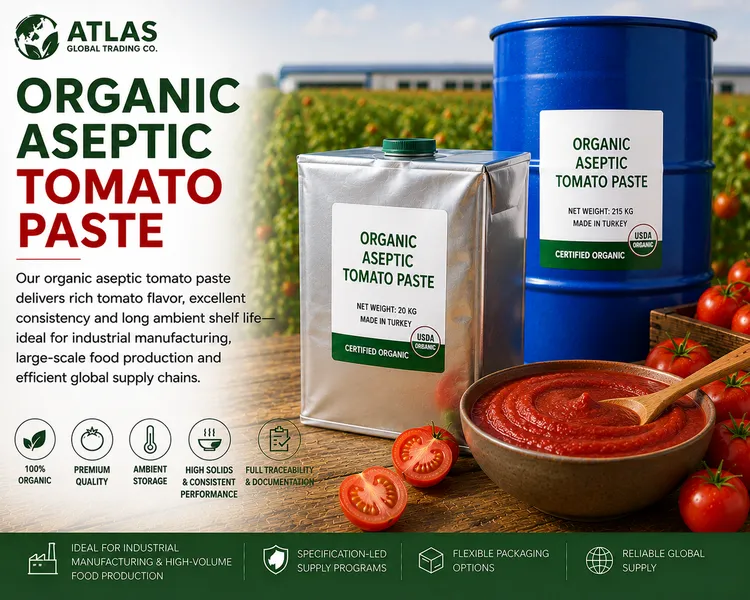
Product overview
Organic aseptic tomato paste is concentrated tomato product processed and filled into a sterile packaging system designed for industrial storage and transport. The format is widely used in high-volume food manufacturing because it allows processors to receive concentrated tomato solids in bulk without relying on conventional retail-style packaging.
Atlas Global Trading Co. sources tomato ingredients through a multi-origin network of farms, processors and supply partners. We match available programs to the customer’s target Brix, process type, consistency, color, pack format, certification requirements, annual volume and delivery destination.
Aseptic packaging format
Typical industrial formats include sterile aseptic bags placed inside steel or fiber drums, as well as larger bin systems for higher-volume operations. Exact net weights, liner construction, valve systems, palletization and container loading vary by processor and origin.
The aseptic system is intended to protect commercially processed product from recontamination after filling. Buyers should follow the storage, handling and opening instructions specified by the processor and approved technical documentation.
Specification focus
For aseptic tomato paste, buyers commonly evaluate soluble solids or Brix, hot break or cold break process where applicable, consistency, color, pH, acidity, flavor profile and microbiological criteria. The required combination depends on the finished application and manufacturing process.
Concentration alone does not determine performance. Two tomato pastes with similar Brix values can behave differently in processing because of differences in break process, natural tomato solids, consistency and other specification parameters. Customers should therefore approve the complete technical specification rather than selecting only by solids level.
Common concentration programs
Industrial tomato paste programs may include commonly traded concentration ranges such as 28–30, 30–32 and 36–38° Brix, subject to origin, processor and crop availability. Higher-solids products can offer freight and storage efficiency, while the optimal concentration depends on the customer’s dilution system, recipe and production requirements.
Typical applications
- Industrial food manufacturing
- Co-packing and contract manufacturing
- Pasta, pizza and cooking sauces
- Soups and soup bases
- Ready meals and prepared foods
- Private-label manufacturing programs
Industrial handling considerations
Bulk aseptic paste is typically integrated into manufacturing systems using controlled unloading, pumping, dilution and blending procedures. Product temperature, pump selection, line configuration and paste consistency can influence handling performance, especially with higher-viscosity products.
Manufacturers should evaluate the selected paste under their own production conditions and confirm that receiving equipment, pumps, extraction systems and storage practices are suitable for the specific pack configuration being purchased.
Storage and shelf-life planning
Aseptic packaging supports ambient industrial storage before opening when the product is stored according to the processor’s specified conditions. Shelf life, recommended temperature range and handling instructions remain product- and processor-specific and should be confirmed on the current technical specification.
Once an aseptic package is opened, the original sterile barrier is no longer intact. Customers should therefore manage opened product according to their validated production procedures and applicable food-safety requirements.
Organic supply and documentation
Where organic supply is requested, we confirm the certification scope and supporting documentation applicable to the selected origin, processor and supply lot. Buyers should communicate the required organic standard and destination market during the inquiry stage so that certification requirements can be reviewed before commercial approval.
Depending on the selected program, documentation may include the current technical data sheet or specification, certificate of analysis, applicable organic certification records and relevant lot or shipment documentation.
Sourcing and commercial planning
Multi-origin sourcing can provide flexibility when customers are balancing specification, crop availability, freight economics, lead time and continuity of supply. For recurring industrial programs, advance volume forecasts and shipment schedules can support more effective supply planning.
A complete inquiry should include target Brix, hot break or cold break preference where relevant, consistency requirements, pack format, annual volume, shipment size, organic certification needs and delivery destination.