
Why this matters
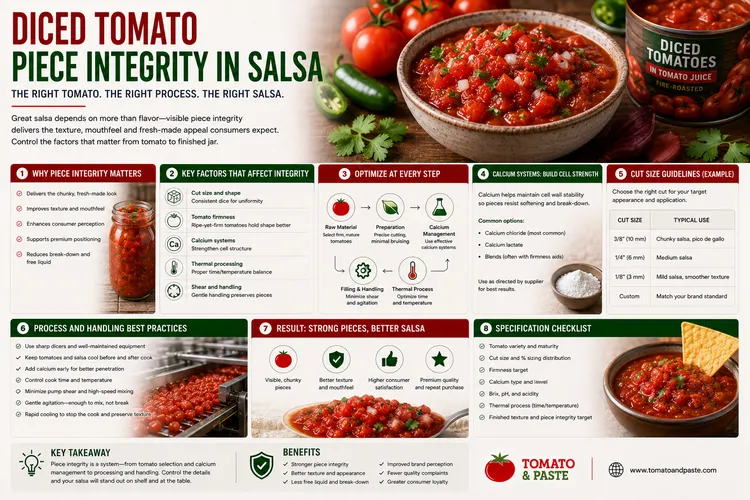
In a chunky salsa, diced tomato pieces are both an ingredient and a visible part of the product identity. Consumers may judge quality partly by whether the pieces remain recognizable, evenly distributed and appropriately firm after mixing, heating, filling and storage.
Sauce performance is controlled by the interaction of tomato insoluble solids, soluble solids, water, acid, salt, vegetables, hydrocolloids and thermal or shear history. A diced tomato that looks excellent when opened may lose definition if the commercial process applies too much heat or mechanical force.
Define the finished salsa style
Start by deciding how much visible tomato identity the product should have. A smooth restaurant-style salsa may tolerate considerable particle breakdown, while a chunky retail salsa may depend on distinct diced pieces in every serving.
Define the desired cut appearance, firmness, spoonability and relationship between tomato pieces and the surrounding sauce phase before evaluating suppliers.
Ingredient selection
Choose a tomato format for the function it must perform: paste for concentrated solids and body, puree for base texture, crushed tomato for smaller particles, and diced tomato for visible piece identity.
For this topic, a logical first ingredient to evaluate is diced tomatoes in juice. Treat that as a formulation hypothesis rather than a fixed rule. The preferred product is the one that delivers the required cut definition and process tolerance while meeting flavor, color, cost and supply targets.
Cut size sets the visual target
Diced tomatoes are available in different cut dimensions, and the incoming piece size influences both visual impact and process behavior. Larger cuts create stronger tomato identity, while smaller dice may distribute more uniformly through the salsa.
Do not evaluate cut size only in the incoming container. Measure or visually assess the pieces after the full commercial process because mixing and pumping can reduce their effective size.
Firmness matters as much as size
Two diced tomato products with similar nominal cuts can behave differently if their firmness differs. Softer pieces may fragment easily under shear, while very firm pieces can feel inconsistent with the intended eating texture.
Evaluate firmness in the finished salsa after the intended thermal process and again after representative storage where shelf life is important.
Understand the calcium system
Calcium treatment can influence the firmness and structural resilience of diced tomato pieces. When piece integrity is a critical specification attribute, ask the supplier how firmness is controlled and which related parameters are included in the product specification.
A firmer diced product is not automatically better. The target should balance process survival with a natural eating texture in the finished salsa.
Juice-to-piece balance
Diced tomato products can differ in the amount and character of surrounding juice. This affects both the visible piece concentration and the water or tomato-solids balance of the salsa.
When comparing suppliers, consider drained pieces, juice contribution and total tomato solids rather than assuming equal ingredient weights provide equal piece density or body.
Normalize the tomato system
If candidate diced products have meaningfully different solids or juice ratios, the first trial should normalize the tomato contribution where practical. Otherwise, one sample may appear thicker or more tomato-forward simply because it contributes more solids.
Once piece integrity has been compared fairly, optimize the final formula around the selected ingredient.
Addition order can protect pieces
Adding diced tomatoes too early may expose them to unnecessary mixing and pumping. In some sauce systems, adding the dice later in the process can reduce mechanical damage and preserve more visible pieces.
The best addition point depends on the thermal process, sanitation requirements, mixer design and ingredient interactions. Trial the real sequence used in production rather than relying solely on gentle laboratory mixing.
Control mechanical shear
Mixers, pumps, valves and transfer lines can all affect piece integrity. High-speed agitation or repeated recirculation can turn diced tomatoes into smaller fragments even when the incoming ingredient is sufficiently firm.
During a plant trial, inspect the product after important mechanical steps. This helps identify where most piece damage occurs and whether equipment settings can be adjusted.
Pump selection and transfer
Piece-containing sauces require transfer equipment that can move the product without creating excessive breakage or blockage. Evaluate the largest particles in the complete salsa, including onion, pepper and other vegetable inclusions.
Observe whether tomato pieces remain intact after pumping from the kettle to the filler and whether distribution remains reasonably uniform throughout the batch.
Thermal process affects texture
Heat softens tomato tissue, and the degree of softening depends on temperature, exposure time, product chemistry and the characteristics of the diced tomato. Longer or more severe processing can reduce visible definition even if mechanical shear is low.
Evaluate the dice after the actual cook, pasteurization, hot-fill or other applicable thermal process rather than approving the ingredient from an unheated sample.
Hold time can be important
A batch may spend meaningful time in a kettle, surge tank or other vessel before filling. Continued heat exposure and agitation during this period can further soften or damage pieces.
Include realistic hold conditions in the pilot or plant trial so the first package and last package from a batch can be compared.
Acid and formulation interactions
Salsa formulations often contain acid, salt, vegetables and other ingredients that influence overall texture and sensory perception. The diced tomato should therefore be evaluated in the complete formula rather than in juice alone.
Any formulation adjustment intended to preserve texture must also remain compatible with the validated safety and quality requirements of the finished product.
Control the surrounding sauce phase
Piece integrity is easier to appreciate when the liquid phase has the right body. If the surrounding sauce is too thin, diced tomatoes may settle or appear visually disconnected. If it is too thick, the product can lose fresh salsa character.
Balance tomato paste or puree, water and any approved texture system so the sauce supports visible pieces without hiding them.
Measure hot and cooled consistency
Salsa can change structure as it cools. Measure viscosity or Bostwick under controlled temperature conditions so different trials are compared on the same basis.
Piece-containing products should also be assessed visually because a numerical consistency value does not fully describe particle distribution or integrity.
Practical trial method
Bench trials should establish the likely formulation, but piece integrity should be confirmed under realistic thermal and mechanical conditions because commercial equipment can create much more stress than manual mixing.
- Define the finished salsa target, including nominal tomato cut, visible piece density, firmness, sauce body and sensory profile.
- Collect current specifications, COAs and representative diced tomato samples from each candidate supplier.
- Record cut dimensions, juice or solids information, firmness or calcium-related information and pack format.
- Normalize tomato contribution where candidate products differ meaningfully in solids or juice ratio.
- Run a controlled bench or pilot batch using the actual ingredient addition order.
- Record mixer speed, mixing time, pump or transfer conditions and hold times.
- Evaluate piece integrity after mixing, after pumping and after the final thermal process.
- Measure Brix or solids, pH, viscosity or Bostwick, yield, color and relevant sensory attributes.
- Repeat evaluation after representative storage to check firmness, separation and piece definition.
- Document the approved supplier, cut size, firmness expectations, processing conditions and change-control triggers.
Score piece integrity consistently
A simple internal scoring system can make supplier comparisons more repeatable. For example, record the amount of recognizable full dice, partial pieces and fine fragments after processing.
Use the same sample size, mixing procedure and observation point for each trial. Photographic references can also help quality and product-development teams maintain a consistent visual standard.
Check piece distribution
Good integrity is not enough if pieces separate unevenly through the batch. Compare samples from early, middle and late filling where practical to determine whether tomato pieces remain uniformly suspended.
Distribution problems may relate to sauce viscosity, tank geometry, agitation or filling equipment rather than the diced tomato itself.
Evaluate after storage
Tomato pieces can continue to soften after production as moisture and acid equilibrate through the finished salsa. A product that looks ideal on production day may have a different texture later in shelf life.
Evaluate retained samples at representative storage intervals for piece firmness, fragmentation, liquid separation, color and overall eating quality.
Compare supplier consistency
Once a suitable diced tomato is identified, understand the supplier's normal lot-to-lot range for cut distribution, firmness, color and juice content. A product that performs consistently may be more useful than one exceptional sample that is difficult to reproduce.
Define which parameters are guaranteed and which are typical so purchasing and quality teams know what variation is expected.
Questions to ask the supplier
- What nominal diced tomato cut size applies to this product?
- What normal cut-size distribution or tolerance should buyers expect?
- How is tomato-piece firmness controlled?
- Is a calcium system used, and how is it reflected in the specification?
- What juice, drained-weight or tomato-solids information is available?
- How well does the product typically tolerate heating and mechanical handling?
- Which parameters are guaranteed versus typical?
- What product definition, process and crop/origin apply to this lot?
- What pH, Brix, color or other technical specifications apply?
- What is the pack configuration, net weight and storage guidance?
- Which food-safety, quality and organic documents are available?
- How are lots identified and traced?
- What changes in cut, firmness system, process, origin or packaging require customer notification?
Define the approved specification
Once the preferred diced tomato is selected, document the attributes that actually drove finished-product approval. These may include nominal cut, cut distribution, firmness, juice ratio, Brix, color, pH, sensory profile and tolerance for broken pieces.
Keep the approved ingredient specification linked to the salsa trial record so future supplier or crop changes can be evaluated against the same performance baseline.