
Product overview
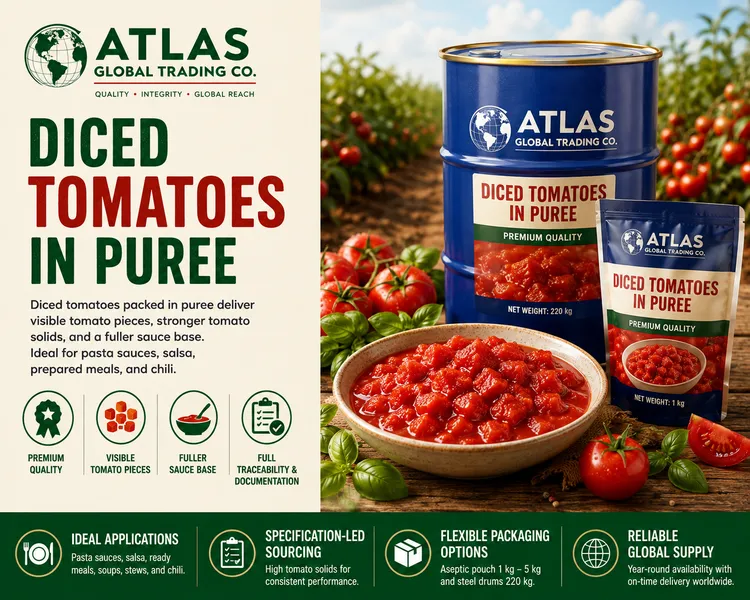
Diced tomatoes in puree combine recognizable tomato pieces with a tomato puree packing medium. This format can provide both particulate texture and background tomato body in a single ingredient, making it useful where manufacturers want visible tomato identity together with stronger overall tomato solids.
Atlas Global Trading Co. sources tomato ingredients through a multi-origin network of farms, processors and supply partners. We match available programs to the customer’s desired dice size, piece integrity, puree consistency, finished-product performance, commercial pack format, certification needs and delivery destination.
Dice size and piece integrity
Dice size is an important selection parameter because it influences both visual appearance and eating texture. Larger pieces may be preferred in chunky sauces, salsa and prepared meals, while smaller dice can integrate more evenly into pizza sauces, fillings and other culinary systems.
Manufacturers should also consider how well the tomato pieces need to retain their shape after pumping, mixing, cooking or thermal processing. Piece integrity can change during production, particularly under high shear or extended cook conditions.
Puree packing medium
Packing diced tomatoes in puree provides a denser tomato background than products packed in a lighter juice medium. The puree contributes additional tomato solids, flavor and body and may reduce the amount of separate puree or paste needed elsewhere in the formulation.
The balance between diced pieces and puree should be reviewed according to the desired finished texture. Some formulations prioritize clearly visible pieces, while others require the puree component to provide most of the sauce body.
Specification focus
Useful when piece identity and background tomato body are needed in the same ingredient. Buyers commonly review dice size and uniformity, piece integrity, puree consistency, soluble solids where relevant, color, flavor, texture, pH, acidity and microbiological parameters.
Product specifications can vary by processor, origin and packing system. Customers should therefore evaluate the complete technical specification rather than assuming that products with the same general description will perform identically in commercial production.
Typical applications
- Pasta and cooking sauces
- Salsa and Mexican-style sauces
- Pizza sauces and toppings
- Prepared meals and ready foods
- Chili, stews and savory bases
- Foodservice and private-label products
Formulation advantages
Combining tomato pieces and puree in one ingredient can simplify formulation by supplying texture and background tomato solids together. Depending on the recipe, manufacturers may use the product as the principal tomato base or blend it with tomato paste for additional concentration and body.
The puree component should be considered when calculating final solids, viscosity and water addition. In sauces and prepared foods, the overall balance between puree, diced tomato and other liquid ingredients can significantly affect finished-product consistency.
Processing considerations
Pump selection, agitation, mixing time and thermal treatment may influence both dice integrity and puree consistency. Customers that require clearly visible tomato pieces should test the ingredient under production-representative conditions before final commercial approval.
For retort, hot-fill or extended-cook applications, the final texture should be assessed after the complete process rather than only when the ingredient is received.
Organic and conventional programs
Where organic supply is requested, we confirm the product’s certification scope and supporting documentation for the selected origin, processor and supply lot. Conventional programs can be optimized around technical performance, economics, origin and continuity of supply.
Depending on the selected supply program, documentation may include the current technical specification, certificate of analysis, applicable certification records and relevant lot or shipment documentation.
Sourcing and commercial planning
Multi-origin sourcing can provide additional flexibility when customers are balancing technical requirements, crop availability, freight economics, lead time and continuity of supply. For recurring programs, forecast volumes and preferred shipment timing help support supply planning.
A complete inquiry should include required dice size, desired piece integrity, puree characteristics, pack format, annual or shipment volume, organic or conventional status, certification requirements and delivery destination.