
Product overview
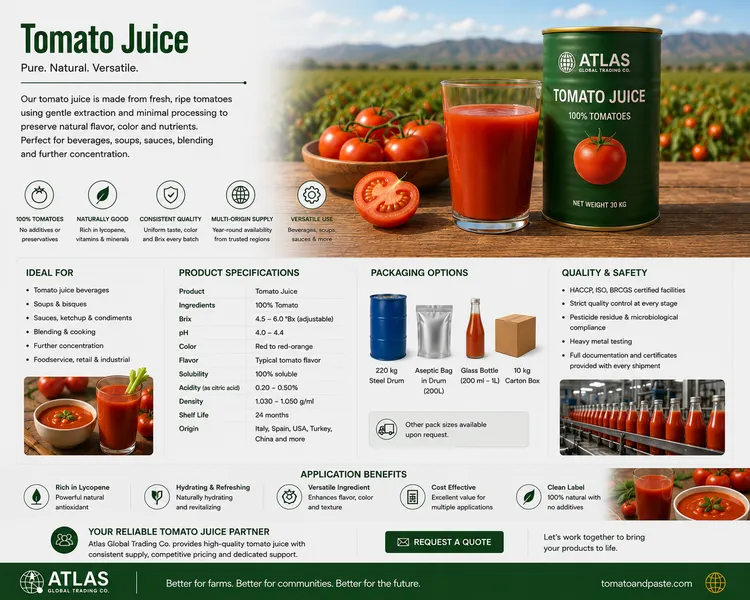
Tomato juice is a versatile liquid tomato ingredient used across beverage, soup, sauce and culinary manufacturing. Depending on the supply program, it can be used directly, blended with other vegetable juices or ingredients, incorporated into prepared-food systems or processed further into a more concentrated tomato ingredient.
Compared with tomato puree or paste, juice generally provides a more fluid tomato base and can be useful where the formulation requires tomato character without excessive body. The preferred balance of solids, pulp and viscosity depends on how the ingredient will be mixed, pumped, heated and combined with the other components of the finished product.
Atlas Global Trading Co. sources tomato ingredients through a multi-origin network of farms, processors and supply partners. We match the ingredient to the customer’s finished-product performance, commercial pack format, documentation requirements, destination and supply program.
Specification focus
Specifications may include soluble solids or Brix, pulp level, consistency, salt, pH, titratable acidity, color, flavor profile and microbiological criteria. The correct specification should reflect the finished application rather than relying on a single analytical value.
Pulp level and consistency can be particularly important in beverage and soup applications because they influence mouthfeel, suspension and visual appearance. Buyers should define whether they require a smoother, more fluid juice or a product with greater natural tomato pulp.
Salt should also be confirmed because some commercial juice programs may differ in formulation. Where the customer requires unsalted, low-salt or a defined sodium contribution, this should be stated explicitly in the sourcing specification.
Color and sensory profile may vary with crop, cultivar, process and storage conditions. For applications where fresh tomato character or a particular color target is commercially important, sample evaluation under the actual finished-product conditions is recommended.
Processing and formulation considerations
Tomato juice can serve as both a flavor ingredient and a source of liquid tomato solids. In beverage systems, manufacturers may evaluate pulp suspension, salt, acidity, spice compatibility and drinking viscosity. In soups and sauces, the same ingredient may instead be assessed for color, tomato intensity, dilution behavior and compatibility with starches, fats and other solids.
For blending or further concentration projects, buyers should consider the incoming solids level and how that affects yield, evaporation load and finished concentration. Normalizing comparisons to usable solids can provide a clearer commercial picture than comparing liquid ingredient prices alone.
Typical applications
- Tomato and vegetable beverages
- Soups and culinary bases
- Sauces and prepared foods
- Vegetable juice blends
- Foodservice tomato preparations
- Further concentration or processing
Packaging and handling
Packaging depends on the processor, target shelf life, commercial volume and handling system. Industrial supply may use aseptic or other bulk liquid formats, while foodservice and retail programs may require smaller packs. Exact configuration is confirmed during quotation.
Receiving teams should verify package integrity, lot identification and applicable storage requirements. Shelf life and storage temperature are product-specific and should follow the current specification and supplier documentation.
Organic and conventional programs
Where organic supply is requested, we confirm the product’s certification scope and supporting documentation for the selected origin and supply lot. Product identity, processor certification and destination-market requirements should remain aligned throughout the supply program.
Conventional programs can be optimized around solids, sensory performance, processing requirements, economics, origin and continuity of supply. Exact analytical limits and commercial availability are confirmed against the selected processor and product program.