
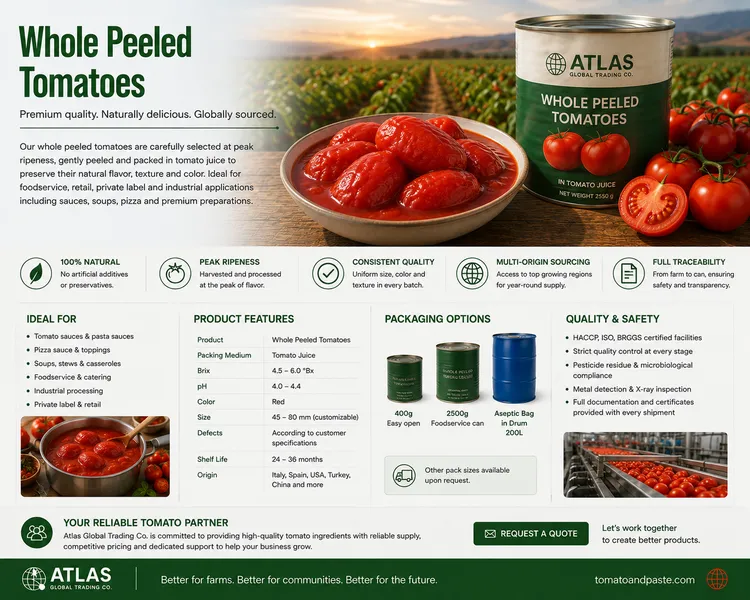
Product overview
Whole peeled tomatoes are a versatile preserved tomato format used where recognizable fruit structure, tomato flavor and processing flexibility are important. After peeling, the tomatoes are packed whole and may be supplied in tomato juice, puree or another product-specific packing medium depending on the processor and commercial program.
They are widely suited to foodservice, private-label and industrial operations that want to retain control over the final texture. A manufacturer can crush, chop, blend or cook the whole fruit during its own process instead of purchasing a fully pre-sized tomato ingredient. This can be useful for premium sauces, pizza applications and products where a more natural tomato appearance is desired.
Atlas Global Trading Co. sources tomato ingredients through a multi-origin network of farms, processors and supply partners. We match the ingredient to the customer’s finished-product performance, commercial pack format, documentation requirements, destination and expected supply program.
Specification focus
Packing medium may include tomato juice or puree, while pack style, cultivar, fruit size and origin can vary by supply program. Buyers may also consider the condition of the fruit, degree of breakage, peel removal, color, flavor, firmness and the amount of free liquid depending on how the product will be used.
For whole peeled tomatoes, the most useful specification is usually different from a tomato-paste specification. Instead of focusing primarily on concentration and viscosity, buyers commonly evaluate fruit integrity, packing medium, drained characteristics, color, sensory profile, defects, product dimensions, net and drained weight, microbiological requirements and pack configuration.
If the whole peeled tomatoes will be crushed or cooked into a finished sauce, it is also useful to evaluate how the product behaves after mechanical breakdown and thermal processing. A bench or pilot trial can help confirm whether the selected program delivers the desired sauce texture, tomato character and yield.
Typical applications
- Foodservice tomato preparations
- Pizza and pizza sauce production
- Pasta, marinara and culinary sauces
- Private-label canned tomato programs
- Industrial crushing and further processing
- Premium prepared foods and ready meals
Pack and processing considerations
Pack format should be matched to the intended handling system and production scale. Foodservice and retail programs often prioritize convenient can or pouch sizes, while larger manufacturing projects may require formats designed for higher-volume use. Exact packaging depends on processor capability and the product program being quoted.
Buyers should also consider how the tomatoes will be emptied, stored, crushed and transferred in their plant. Whole-fruit integrity may be important during receipt but less important after mechanical processing, so the correct commercial specification should reflect the actual finished-product requirement rather than appearance alone.
Organic and conventional programs
Where organic supply is requested, we confirm the product’s certification scope and supporting documentation for the selected origin and supply lot. Organic identity, processor certification and applicable destination-market documentation should remain aligned throughout the supply chain.
Conventional programs can be optimized around technical performance, economics, origin, packaging and continuity of supply. Because crop conditions and processor capabilities can vary, final product parameters and commercial availability are confirmed during quotation.