
Product overview
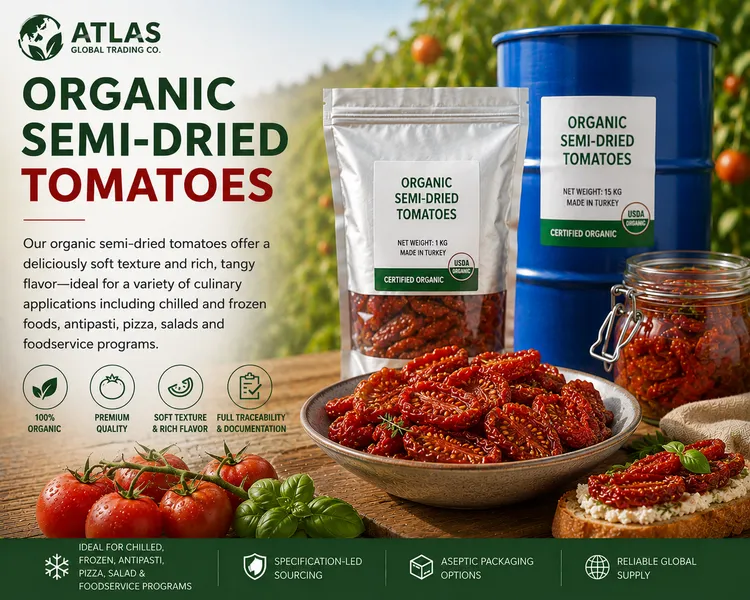
Organic semi-dried tomatoes are partially dehydrated tomato products designed to retain more natural moisture and a softer bite than fully sun-dried tomatoes. This texture makes them particularly suitable for antipasti, salads, pizza toppings, sandwiches, chilled foods and foodservice applications where a tender tomato piece is preferred.
Depending on processor capability, products may be offered as halves, wedges, strips or other cut formats. Commercial programs may also differ in whether the tomatoes are supplied plain, seasoned, marinated in oil, pasteurized, chilled or frozen.
Atlas Global Trading Co. sources tomato ingredients through a multi-origin network of farms, processors and supply partners. We match the ingredient to the customer’s required organic certification, cut format, moisture and texture, pack medium, storage condition, technical documentation, destination and supply program.
Specification focus
Moisture and texture are central purchasing parameters because semi-dried tomatoes are intentionally softer than fully dried formats. Buyers should define whether they require a firmer bite for toppings and salads or a softer texture for antipasti, sandwiches and prepared foods.
Cut or piece format should also be specified. Halves, wedges, strips and other shapes can perform differently in portioning, mixing, topping and final visual presentation. Where consistency matters, tolerances for broken pieces or undersized material may be agreed with the processor.
Salt, oil, seasonings and preservation system can vary by product program. Buyers should review the complete ingredient statement and confirm whether they require a plain tomato format or a marinated system with specific oil, herbs or seasoning restrictions.
Color, flavor, piece integrity and microbiological criteria may also be part of the approved specification. Because the product retains more moisture than fully dried tomatoes, storage and preservation conditions should be reviewed carefully for the selected pack and process.
Plain and marinated programs
Plain semi-dried tomatoes provide greater flexibility for manufacturers that want to control seasoning, oil and flavor in their own formulation. Marinated programs can reduce downstream preparation where the product is intended for antipasti, foodservice or ready-to-use chilled applications.
Where a marinated product is requested, buyers should specify the preferred oil system, seasoning profile and any ingredient restrictions. Final composition, organic eligibility and labeling should be confirmed from the current specification rather than assumed.
Chilled, frozen and pasteurized formats
Semi-dried tomatoes may require chilled or frozen distribution depending on moisture, formulation and preservation system. Other programs may use a validated pasteurization and packaging approach appropriate to the selected product.
The correct storage condition is therefore product specific. Buyers should confirm temperature requirements, shelf life, handling after opening and any thawing or tempering instructions before approving a commercial program.
Application and processing behavior
The softer structure of semi-dried tomatoes can provide an immediately tender bite without the same degree of rehydration required by drier formats. This can be beneficial in chilled foods, sandwiches, pizza and antipasti where the tomato is consumed as a visible inclusion.
Mechanical mixing and thermal processing can change piece integrity. Where the tomato pieces should remain visually distinct, manufacturers should consider the addition point, mixer intensity and total cooking time.
Pilot or production trials can help confirm final texture, flavor and visual performance when a new cut, moisture level or marinated system is introduced.
Typical applications
- Antipasti and marinated vegetable programs
- Pizza and flatbread toppings
- Salads and chilled prepared foods
- Sandwiches, wraps and fillings
- Foodservice and institutional kitchens
- Ready meals and premium prepared foods
Packaging and storage
Organic semi-dried tomatoes may be supplied in pouches, tubs, cartons, bags, foodservice packs or frozen configurations depending on the product and processor. Marinated formats may also be supplied with an oil or other approved packing medium.
Receiving teams should verify pack integrity, lot coding, storage temperature, shelf-life documentation and handling instructions. Chilled and frozen products should remain within the specified storage pathway, while opened packs should be handled according to the processor’s current instructions.
Organic program controls
Organic certification is a core part of the product specification. We confirm certification scope and supporting records for the selected processor, origin and supply lot, including relevant chain-of-custody documentation where applicable.
Where oil, seasoning, herbs or other ingredients are present, the complete formulation should be reviewed for compatibility with the intended organic program. Buyers should also provide the destination market and any customer-specific certification requirements.
Final organic claims should remain aligned with the approved product composition, processor certification, supply documentation and destination-market requirements.