
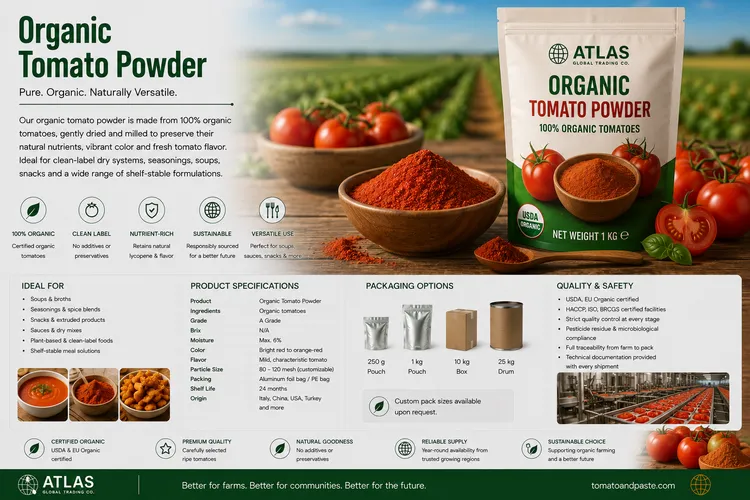
Product overview
Organic tomato powder is a shelf-stable dry tomato ingredient used where manufacturers need concentrated tomato flavor, color and solids in a format that is easy to meter into dry or low-moisture formulations. Depending on the selected processor, products can differ in drying method, carrier system, particle size, color intensity and functional behavior.
Common applications include seasoning blends, soup systems, snack coatings, dry sauces, bakery products, savory mixes and other formulations where liquid tomato ingredients would add unwanted water or complicate dry blending.
Atlas Global Trading Co. sources tomato ingredients through a multi-origin network of farms, processors and supply partners. We match the ingredient to the customer’s finished-product performance, organic certification requirements, commercial pack format, technical documentation, destination and supply program.
Specification focus
Organic certification, carrier status, mesh or particle size, moisture, color and intended application should be confirmed before approval. These parameters can materially affect formulation behavior even when two products are both sold under the same general name.
Carrier status is particularly important. Some tomato powders may use a permitted carrier or processing aid to support drying or handling, while other programs may be designed around a different composition. Buyers should therefore review the complete ingredient statement and organic certification scope rather than assuming that all tomato powders have identical composition.
Particle size or mesh influences blend uniformity, dusting, appearance, dispersibility and how quickly the ingredient hydrates. Fine powders may distribute efficiently through seasoning or dry sauce systems, while different particle profiles may be preferred where handling or processing equipment has specific requirements.
Moisture is another key commercial parameter because it affects shelf-life stability, flowability and susceptibility to caking. Packaging and warehouse conditions should therefore be selected to minimize unnecessary exposure to humidity.
Color and flavor
Tomato powder can contribute both visible red color and concentrated tomato flavor. Buyers may define expectations for color intensity, characteristic tomato aroma, cooked notes and the absence of undesirable off-flavors.
Sensory performance should be evaluated at the intended use level because seasoning concentration, salt, fat, spices and thermal processing can change how the tomato character is perceived in the finished product.
Flowability and dry blending
Flow behavior is important for plants using automated feeders, augers, hoppers or high-speed blending equipment. Moisture, particle size, bulk density and powder composition can all influence how consistently the material feeds through production equipment.
For large-scale dry blending, manufacturers may want to evaluate segregation, caking tendency and dosing repeatability. Bench and plant trials can help confirm that the selected powder performs reliably in the customer's actual handling system.
Dispersibility and hydration
In soup, sauce or beverage-type applications, the rate at which tomato powder disperses and hydrates can influence processing efficiency and final texture. Mixing intensity, water temperature, contact time and the presence of fats, starches or other dry ingredients can affect dispersion.
Where smooth reconstitution is important, the powder should be tested under realistic process conditions to confirm that the selected mesh, composition and addition sequence produce the desired result.
Typical applications
- Organic seasoning and spice blends
- Soups and instant meal systems
- Snack coatings and savory flavors
- Dry sauces and culinary mixes
- Bakery and savory dough systems
- Nutrition and shelf-stable dry blends
Packaging and storage
Organic tomato powder is generally supplied in moisture-protective dry packaging such as lined industrial bags, cartons or other processor- approved commercial formats. Exact pack size and liner configuration depend on the supply program.
Receiving teams should inspect package integrity, lot identification, shelf-life documentation and storage instructions. Once opened, exposure to humidity should be minimized and the product should be handled according to the current approved specification.
Organic program controls
Organic certification is a core part of the product specification. We confirm certification scope and supporting records for the selected processor, product composition, origin and supply lot.
Where a carrier or other processing input is present, its compatibility with the intended organic program and final product claim should be reviewed. Buyers should also provide the destination market and any customer-specific certification expectations during inquiry.
Final organic claims should remain aligned with the approved ingredient statement, processor certification, documentation and destination-market requirements.